
Causes of anthropogenic climate change and the greenhouse effectSpec 5.17
In short
Anthropogenic climate change is caused by human activities that raise concentrations of greenhouse gases. The greenhouse effect occurs when gases such as carbon dioxide and methane absorb long-wavelength infra-red radiation emitted by Earth and re-radiate it, warming the lower atmosphere. More greenhouse gases enhance this effect and cause global warming.
The greenhouse effect
- Short-wavelength radiation (visible light) from the Sun passes through the atmosphere. Some is reflected, and the rest is absorbed by Earth’s surface and warms it.
- The warmed surface emits radiation at longer wavelengths, as infra-red radiation (heat).
- Greenhouse gases in the atmosphere absorb some of this infra-red radiation and re-radiate it in all directions, including back towards Earth’s surface.
- This traps heat, and keeps the lower atmosphere warmer than it would be otherwise. This natural process keeps average temperatures suitable for life.
The main greenhouse gases are carbon dioxide, methane, water vapour, nitrous oxide and CFCs. They differ in how long they stay in the atmosphere and in how effective they are at absorbing infra-red radiation: for each molecule, methane is more effective than carbon dioxide, but carbon dioxide is far more abundant.
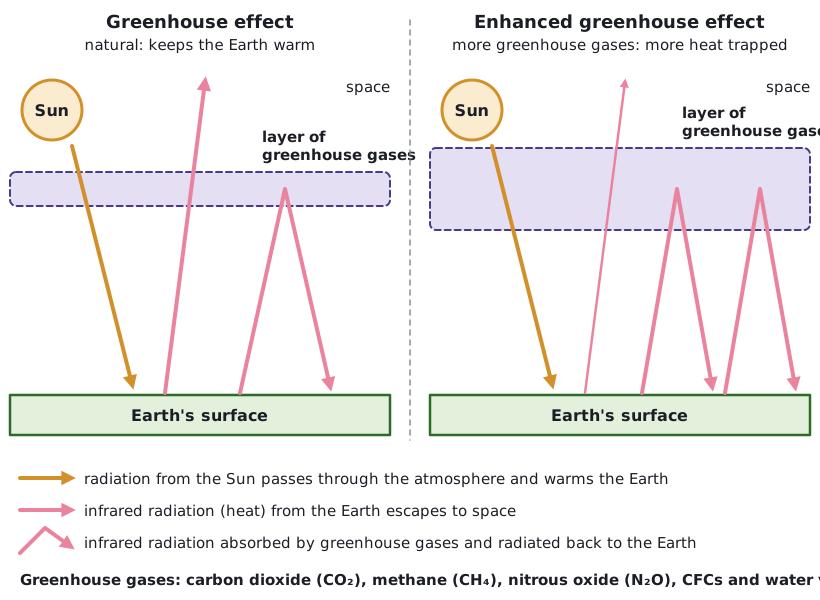 (opens full size in a new tab)
Anthropogenic causes
Anthropogenic means caused by humans. Since the industrial revolution, human activities have increased the concentrations of greenhouse gases, an enhanced greenhouse effect that has led to global warming.
| Human activity | Greenhouse gas affected | Effect |
|---|---|---|
| Burning fossil fuels (coal, oil, gas) in power stations, transport and industry | Carbon dioxide | Releases carbon that has been locked up in fossil fuels for millions of years |
| Deforestation, especially by burning | Carbon dioxide | Burning and decay release stored carbon; fewer trees remove less carbon dioxide by photosynthesis |
| Cattle and sheep farming; rice paddies; landfill | Methane | Ruminants release methane from digestion; waterlogged soils and rotting waste give anaerobic decomposition |
| Use of nitrogen fertilisers | Nitrous oxide | Released by denitrifying bacteria in the soil |
| Use of refrigerants and aerosol propellants (CFCs) | CFCs | Absorb infra-red radiation strongly (CFCs also damage the ozone layer) |
The greenhouse effect itself is natural and essential. It is the enhanced greenhouse effect, caused by extra greenhouse gases, that leads to climate change. The ozone layer is a different issue.
Written and checked against the Edexcel International A Level Biology (YBI11) specification · Updated October 2026