
Sex linkage and red-green colour blindnessSpec 2.15
In short
A sex-linked gene is carried on a sex chromosome. Red-green colour blindness is caused by a recessive allele on the X chromosome. Males (XY) have only one X chromosome, so one copy of the allele causes the condition, whereas females (XX) need two copies, so the condition is more common in males.
Human females have two X chromosomes (XX) and males have one X and one Y (XY). The Y chromosome is shorter and carries few of the genes found on the X chromosome. A sex-linked characteristic is controlled by a gene on a sex chromosome, and here we consider genes on the X chromosome.
Red-green colour blindness is caused by a recessive allele on the X chromosome. The alleles are written as superscripts on the X: Xᴮ (normal colour vision, dominant) and Xᵇ (colour blind, recessive).
| Genotype | Phenotype |
|---|---|
| XᴮXᴮ | Female, normal colour vision |
| XᴮXᵇ | Female, normal colour vision, carrier of the allele |
| XᵇXᵇ | Female, colour blind |
| XᴮY | Male, normal colour vision |
| XᵇY | Male, colour blind |
A cross involving a carrier mother
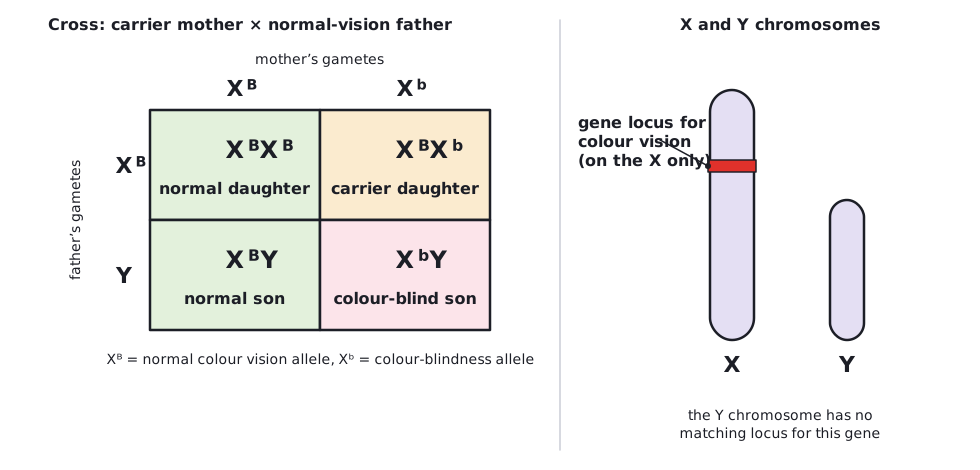
A woman who is a carrier of red-green colour blindness (XᴮXᵇ) has children with a man with normal colour vision (XᴮY). Give the possible genotypes and phenotypes of their children.
- Gametes from the mother: Xᴮ or Xᵇ. Gametes from the father: Xᴮ or Y.
- Daughters: XᴮXᴮ (normal) or XᴮXᵇ (carrier, normal vision).
- Sons: XᴮY (normal) or XᵇY (colour blind).
Answer: Half of the sons (so 1 in 4 of all children) are colour blind; no daughters are colour blind, but half the daughters are carriers.
Why the condition is more common in males
- A male has only one X chromosome, so a single recessive allele on it is always expressed (there is no second allele to mask it).
- A female must inherit the recessive allele on both of her X chromosomes to show the condition.
- A male inherits his X chromosome from his mother, never from his father. A colour-blind man passes the allele to all of his daughters (who become carriers) and to none of his sons.
Write sex-linked genotypes with the X, and the allele as a superscript, and always include the Y for males. Marks are lost for writing the alleles without the sex chromosomes.
 (opens full size in a new tab)
Written and checked against the Edexcel International A Level Biology (YBI11) specification · Updated October 2026