
Anaerobic respiration and lactateSpec 7.2, 7.5
In short
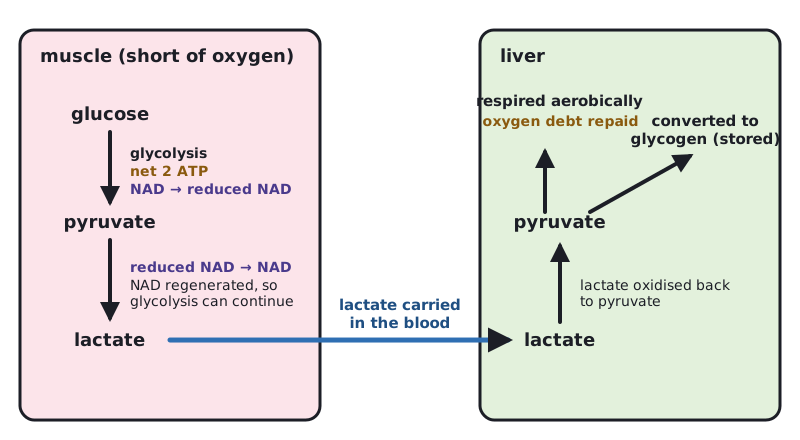
In animals, anaerobic respiration is glycolysis followed by the conversion of pyruvate to lactate, which regenerates the NAD that glycolysis needs. After the period of anaerobic respiration, lactate is carried in the blood to the liver, where it is converted back to pyruvate and oxidised or converted to glycogen.
When oxygen is in short supply, as in muscle during vigorous exercise, the electron transport chain cannot work. Reduced NAD cannot be oxidised, so there would be no NAD for glycolysis. Anaerobic respiration solves this.
- Glycolysis continues, giving a net gain of 2 ATP per glucose.
- Pyruvate accepts hydrogen from reduced NAD and is converted to lactate.
- This reforms NAD, so glycolysis can carry on making ATP, although only a small amount compared with aerobic respiration.
Lactate lowers the pH of the muscle cells, which interferes with enzyme action and contributes to muscle fatigue.
What happens to lactate
- Lactate diffuses out of the muscle cells into the blood and is carried to the liver.
- When enough oxygen is available again, in the liver the lactate is oxidised back to pyruvate.
- Some pyruvate enters aerobic respiration (link reaction, Krebs cycle and oxidative phosphorylation) to release ATP; the rest is converted to glucose and then glycogen for storage.
- Extra oxygen is taken in for some time after the exercise. This is why breathing stays fast and deep: the oxygen debt is being repaid.
Lactate does not build up because there is 'no oxygen' in the cell. It forms because pyruvate has to accept hydrogen so that NAD is regenerated. Say that glycolysis would stop without it.
 (opens full size in a new tab)
Quick check
In which part of the cell does glycolysis take place?
Show answer
In the cytoplasm.
How many ATP molecules are made by glycolysis, net, per glucose molecule?
Show answer
Two (four are made, two are used).
What are the products of the link reaction?
Show answer
Acetyl CoA, carbon dioxide and reduced NAD.
What is the role of oxygen in aerobic respiration?
Show answer
It is the final electron acceptor, combining with electrons and protons to form water.
Why does glycolysis stop if pyruvate cannot be converted to lactate in anaerobic conditions?
Show answer
Reduced NAD would not be oxidised, so NAD would not be regenerated for glycolysis.
Written and checked against the Edexcel International A Level Biology (YBI11) specification · Updated October 2026