
Sewage, fertiliser and eutrophicationSpec 20.3.1, 20.3.4
In short
Eutrophication is the chain of events when extra nitrate and other ions from excess fertiliser or untreated sewage enter water. Algae and water plants grow fast and block light, so producers deeper down die. Decomposers increase and their aerobic respiration uses up dissolved oxygen, so fish and other organisms that need dissolved oxygen die.
Untreated sewage and excess fertiliser both contain nitrates and other ions. If they get into rivers and lakes, they harm aquatic ecosystems.
- Untreated sewage also contains microorganisms that cause disease and organic matter that decomposers break down using oxygen.
- Excess fertiliser is washed (leached) from fields by rain into streams and rivers.
- The extra ions cause water plants and algae to grow quickly. When they die, decomposers break them down and use up oxygen in the water, so fish and other aquatic organisms die.
Supplement (what this means)
Supplement: only for the Extended papers (2 and 4). Core students can skip it. What the labels meanEutrophication
Supplement (what this means)
Supplement: only for the Extended papers (2 and 4). Core students can skip it. What the labels mean- Nitrate and other ions increase in availability in the water.
- Producers (algae and water plants) grow faster, forming an algal bloom that blocks light.
- Producers deeper in the water cannot photosynthesise and die; there is increased decomposition after their death.
- Decomposers (bacteria) increase in number and carry out increased aerobic respiration.
- The decomposers use up oxygen, so there is a reduction in dissolved oxygen.
- Organisms that require dissolved oxygen, such as fish and insect larvae, die.
Supplement (what this means)
Supplement: only for the Extended papers (2 and 4). Core students can skip it. What the labels mean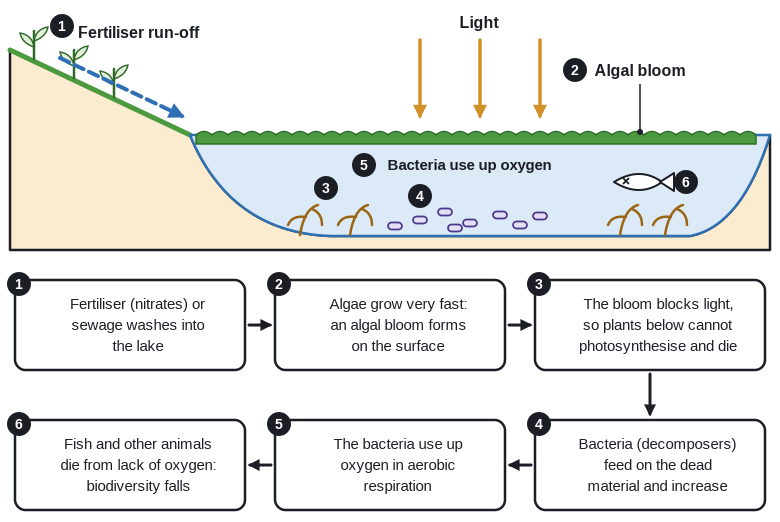 (opens full size in a new tab)
Supplement (what this means)
Supplement: only for the Extended papers (2 and 4). Core students can skip it. What the labels meanDo not say the algae 'use up the oxygen'. It is the decomposers' aerobic respiration, after the producers die, that lowers dissolved oxygen.
| Untreated sewage | Excess fertiliser | |
|---|---|---|
| How it gets into the water | Released into rivers and lakes without being treated | Washed (leached) from fields by rain into streams and rivers |
| What it adds to the water | Nitrate and other ions, microorganisms that cause disease, and organic matter that decomposers break down using oxygen | Nitrate and other ions |
| Effect on the aquatic ecosystem | Water plants and algae grow quickly; decomposers use up oxygen; fish and other organisms die | Water plants and algae grow quickly; decomposers use up oxygen; fish and other organisms die |
Supplement (what this means)
Supplement: only for the Extended papers (2 and 4). Core students can skip it. What the labels meanExam-style question
Supplement (what this means)
Supplement: only for the Extended papers (2 and 4). Core students can skip it. What the labels meanExplaining why fish die
Excess fertiliser is washed into a lake. A few weeks later, many fish in the lake die. Explain why. [5]
- The fertiliser increases the availability of nitrate ions in the water (1 mark).
- Producers such as algae grow faster (1 mark).
- Producers die, so there is increased decomposition by decomposers (1 mark).
- There is increased aerobic respiration by the decomposers, which reduces the dissolved oxygen (1 mark).
- Fish need dissolved oxygen for aerobic respiration, so they die (1 mark).
Answer: Extra nitrate, more producer growth, more decomposition and aerobic respiration by decomposers, less dissolved oxygen, so the fish die.
Common wrong answers
- The fertiliser poisons the fish. The fish die because there is not enough dissolved oxygen, not because the fertiliser is toxic.
- Writing 'pollution kills the fish'. Give the chain of events in order, from extra ions to the fall in oxygen.
Supplement (what this means)
Supplement: only for the Extended papers (2 and 4). Core students can skip it. What the labels mean- The decomposers respire anaerobically. It is their increased aerobic respiration that uses up the dissolved oxygen.
Written and checked against the Cambridge IGCSE Biology (0610) specification · Updated October 2026