

Asexual reproductionSpec 16.1.1, 16.1.2, 16.1.3
Asexual reproduction is a process resulting in the production of genetically identical offspring from one parent. There are no gametes and no fusion of nuclei, so there is no mixing of genetic information. The offspring are clones of the parent.
- Asexual reproduction
- A process resulting in the production of genetically identical offspring from one parent.
Spotting examples of asexual reproduction
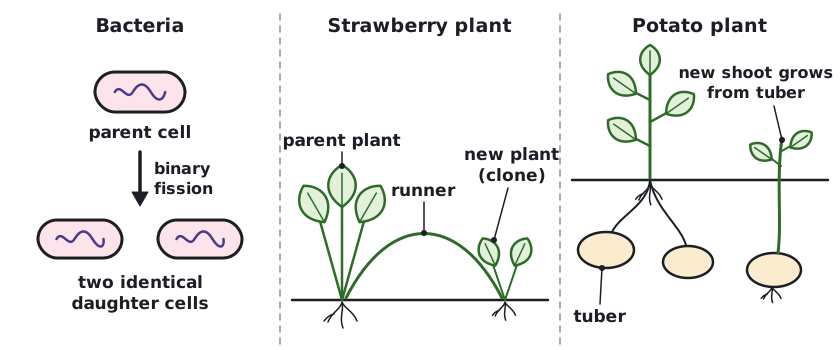
You must be able to identify asexual reproduction in diagrams, images and information you are given. Look for one parent only, and offspring that are copies of it.
| Organism | What happens |
|---|---|
| Bacteria | A bacterial cell divides in two (binary fission). Each new cell is genetically identical to the parent cell. |
| Strawberry plant | The parent plant grows horizontal stems called runners. A new plant grows from a bud on the runner and becomes separate from the parent. |
| Potato plant | Underground stems swell to form tubers. Each tuber can grow into a new plant that is genetically identical to the parent. |
| Daffodil | New bulbs grow from buds on the parent bulb. Each one separates and grows into a new plant that is genetically identical to the parent. |
| Fungi (such as bread mould) | The parent releases spores. Each spore can grow into a new fungus. |
 (opens full size in a new tab)
Exam tip:
In a 'spot the example' question, give the reason: only one parent is involved and the offspring are genetically identical to it.
Supplement (what this means)
Supplement: only for the Extended papers (2 and 4). Core students can skip it. What the labels meanAdvantages and disadvantages of asexual reproduction
Supplement (what this means)
Supplement: only for the Extended papers (2 and 4). Core students can skip it. What the labels mean| Advantages | Disadvantages | |
|---|---|---|
| To a population of a species in the wild | Only one parent is needed, so no mate has to be found. It is quick and uses less energy. Many offspring can be produced in a short time. A population can spread quickly into a favourable environment where it is well adapted. | There is no genetic variation, so all the individuals are equally affected by a change in the environment or by a new disease. The population may not survive. There is no new variation for natural selection to act on. |
| To crop production | All the plants have the same desirable features, so the crop is uniform in size, yield and quality. A plant with useful features can be copied exactly. Many plants can be produced quickly and cheaply. | All the plants are equally susceptible to the same disease or pest, so the whole crop can be lost. There is no variation, so no new varieties are produced. |
Common mistake:
Do not write that asexual offspring are 'similar' to the parent. The mark is for 'genetically identical'.