Book a tutor

Specialised cells

Organisation of the organism · Cell structure · note 3 of 4

Specialised cellsSpec 2.1.5, 2.1.6

In short

A specialised cell is a cell with a specific function, whose shape and contents suit it to that job. Root hair cells have a long extension for absorption, red blood cells contain haemoglobin for the transport of oxygen, and ciliated cells move mucus in the trachea and bronchi. New cells are produced by division of existing cells.

New cells are produced by division of existing cells. This is how an organism grows and how damaged cells are replaced.

In many organisms, cells become specialised. A specialised cell has a specific function. Its shape and contents are suited to doing that job.

Specialised cells and their functions
CellFunctionFeature that helps
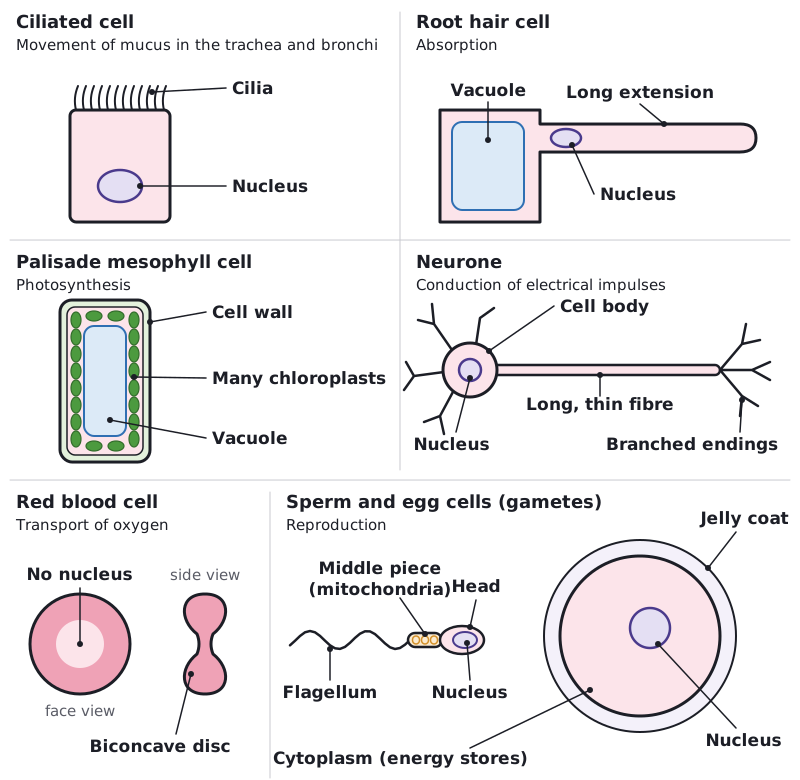
Ciliated cellMovement of mucus in the trachea and bronchiCilia on the surface sweep mucus along
Root hair cellAbsorptionLong extension gives a large surface area for uptake of water and mineral ions
Palisade mesophyll cellPhotosynthesisContains many chloroplasts
NeuroneConduction of electrical impulsesLong, thin fibre carries impulses
Red blood cellTransport of oxygenContains haemoglobin, which carries oxygen
Sperm and egg cells (gametes)ReproductionSperm has a flagellum to swim to the egg; egg has energy stores and a jelly coat
Specialised cells with their functions: ciliated cell with cilia and nucleus; root hair cell with long extension, nucleus and vacuole; palisade mesophyll cell with cell wall, many chloroplasts and vacuole; neurone with cell body, nucleus, long thin fibre and branched endings; red blood cell, a biconcave disc with no nucleus; sperm cell with head, nucleus, middle piece and flagellum next to a larger egg cell with jelly coat, nucleus and cytoplasm. (opens full size in a new tab)
Each specialised cell is labelled with its function. Cells are not drawn to the same scale.
Exam tip:

This point asks you to state the function of each cell, in the wording of the middle column. 'Root hair cells: absorption' and 'red blood cells: transport of oxygen' are the answers examiners expect.

Written and checked against the Cambridge IGCSE Biology (0610) specification · Updated October 2026

Frequently asked questions

What is the difference between plant and animal cells?

Plant cells have a cellulose cell wall, chloroplasts and a large vacuole containing cell sap, which animal cells do not have. Both types of cell have a cell membrane, cytoplasm, a nucleus, ribosomes and mitochondria. In an exam, name a structure only one cell has, for example 'plant cells have a cell wall, animal cells do not'.

Why do plant cells have a cell wall?

Plant cells have a cell wall because it strengthens the cell and supports it. The wall is made of cellulose and is fully permeable, so it does not control what enters the cell; that is the job of the cell membrane. The large vacuole of cell sap also helps keep the cell firm.

What is the difference between a bacterial cell and a plant cell?

A bacterial cell has no nucleus, chloroplasts or large vacuole. Its DNA is a single circular loop free in the cytoplasm, often with extra rings called plasmids. Like a plant cell, it has a cell wall, cell membrane, cytoplasm and ribosomes, but the bacterial cell wall is not made of cellulose.

All 5 questions on Cell structure