

Investigating osmosisSpec 3.2.4, 3.2.5
You need to be able to investigate osmosis using dialysis (Visking) tubing, and to investigate the effects of different concentrations of solution on plant tissues.
Dialysis tubing
- Soak a length of dialysis tubing, tie one end tightly and fill it with a concentrated sucrose (sugar) solution.
- Tie the other end, rinse the outside and blot dry. Measure the mass.
- Place the bag in a beaker of water for a set time.
- Remove the bag, blot dry and measure its mass again.
The mass of the bag increases because water moves into the bag by osmosis through the partially permeable tubing. The sucrose molecules are too large to pass out. If the bag contains water and is placed in concentrated sucrose solution, its mass decreases.
Plant tissue
Use identical cylinders of potato, cut with a cork borer, in a range of sugar solution concentrations including distilled water. Take care with the cork borer and scalpel, and cut on a tile.
- Cut cylinders of potato of the same length and diameter. Blot each dry and measure its mass.
- Place one cylinder in each of a range of sugar solutions (for example 0.0, 0.2, 0.4, 0.6, 0.8 mol/dm³), using the same volume in each tube.
- Leave for the same time at the same temperature.
- Remove, blot dry in the same way and measure the mass again.
- Calculate the percentage change in mass for each cylinder.
- Independent variable: concentration of the sugar solution.
- Dependent variable: percentage change in mass.
- Control variables: type and size of potato, volume of solution, temperature, time, how the tissue is dried.
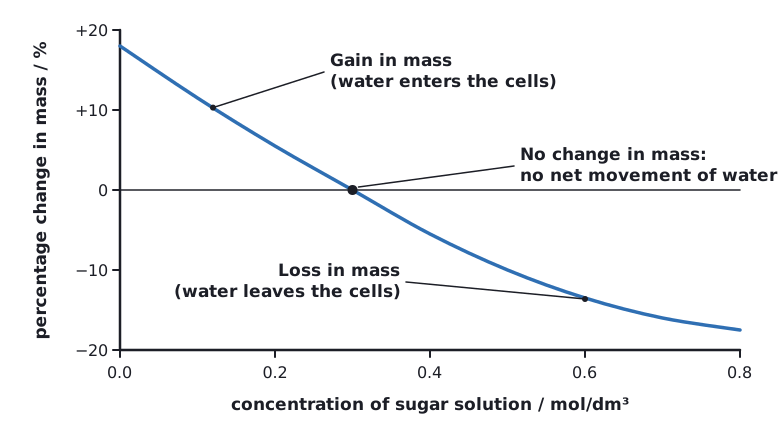
In dilute solutions, the potato gains mass because water enters its cells. In concentrated solutions, it loses mass because water leaves its cells. Where the line on a graph of percentage change against concentration crosses the x-axis, there is no change in mass, so the solution has the same concentration as the inside of the potato cells.
Percentage change in mass
A potato cylinder has a mass of 4.0 g at the start and 3.4 g after 30 minutes in a sugar solution. Calculate the percentage change in mass.
- Change in mass = 3.4 − 4.0 = −0.6 g.
- Percentage change = −0.6 ÷ 4.0 × 100 = −15%.
Answer: −15% (a 15% decrease in mass).
Use the initial mass as the divisor and show the sign: a loss is negative. When you draw the graph, put concentration on the x-axis and use a line of best fit.
 (opens full size in a new tab)