

Arteries, veins and capillariesSpec 9.3.1, 9.3.2, 9.3.4, 9.3.5
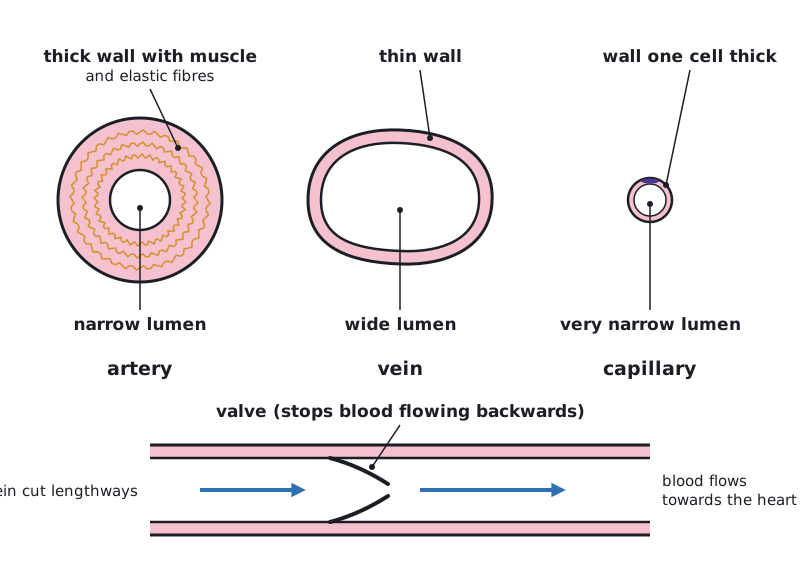
| Vessel | Wall | Lumen | Valves |
|---|---|---|---|
| Artery | Thick | Narrow | No |
| Vein | Thin | Wide | Yes |
| Capillary | One cell thick | Very narrow | No |
 (opens full size in a new tab)
Capillaries are the site of exchange. They allow substances such as oxygen, glucose and carbon dioxide to pass between the blood and the cells of the body tissues.
Supplement (what this means)
Supplement: only for the Extended papers (2 and 4). Core students can skip it. What the labels meanStructure related to pressure
Supplement (what this means)
Supplement: only for the Extended papers (2 and 4). Core students can skip it. What the labels mean- Arteries carry blood away from the heart at high pressure. Their thick walls, containing muscle and elastic fibres, withstand the pressure and stretch and recoil with each beat. The narrow lumen helps to maintain the pressure.
- Veins carry blood back to the heart at low pressure. They need only thin walls, and the wide lumen gives little resistance to flow. Valves stop the blood flowing backwards.
Supplement (what this means)
Supplement: only for the Extended papers (2 and 4). Core students can skip it. What the labels meanStructure of capillaries related to function
Supplement (what this means)
Supplement: only for the Extended papers (2 and 4). Core students can skip it. What the labels mean- Walls are one cell thick, giving a short distance for diffusion.
- Walls are permeable, so substances in the blood plasma can leak out and pass in.
- They are very narrow and form a large network (large surface area) close to every cell, and the slow flow gives time for exchange.
Supplement (what this means)
Supplement: only for the Extended papers (2 and 4). Core students can skip it. What the labels meanExam tip:
Do not say that veins have 'no muscle'. Say their walls are thinner because the blood is at lower pressure.