Sense organs and the eyeSpec 14.2.1, 14.2.2, 14.2.3
In short
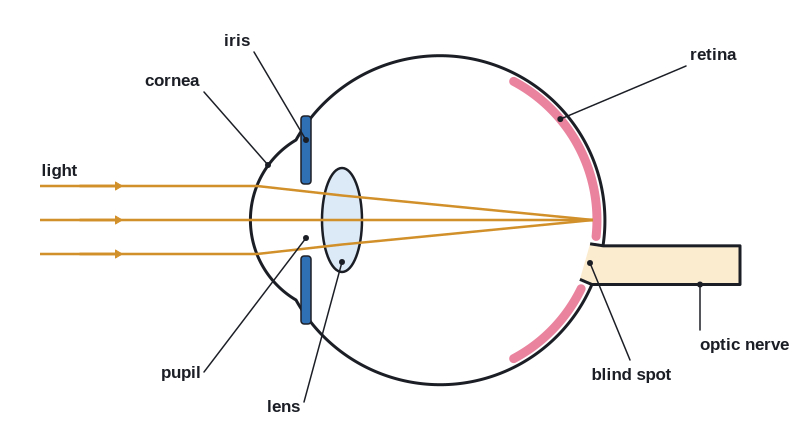
The eye is a sense organ: a group of receptor cells responding to light. The cornea refracts light as it enters, the iris controls how much light enters the pupil, and the lens focuses light on to the retina. The retina contains light receptors, and the optic nerve carries impulses to the brain. The blind spot has no receptors.
Sense organs are groups of receptor cells responding to specific stimuli: light, sound, touch, temperature and chemicals. The eye is a sense organ that responds to light.
| Structure | Function |
|---|---|
| Cornea | Refracts (bends) light as it enters the eye |
| Iris | Controls how much light enters the pupil |
| Pupil | The hole in the centre of the iris through which light enters |
| Lens | Focuses light on to the retina |
| Retina | Contains light receptors, some sensitive to light of different colours |
| Optic nerve | Carries impulses to the brain |
| Blind spot | The place where the optic nerve leaves the eye. It has no receptors, so it is not sensitive to light |
 (opens full size in a new tab)
Give the job of each structure with the exact verb: the cornea refracts light, the lens focuses light, the iris controls how much light enters. The optic nerve carries impulses, not images, to the brain.
The path of light through the eye
- Light enters through the cornea, which refracts it.
- Light passes through the pupil. The iris controls how much light gets in.
- The lens focuses the light on to the retina.
- Light receptors in the retina are stimulated and send impulses.
- The optic nerve carries the impulses to the brain.
Exam-style question
Identify and state the function
On a diagram of the eye, structure A is the clear front part of the eye and structure B is the nerve leaving the back of the eye. Name A and B and state the function of each. [4]
- A is the cornea (1 mark). It refracts light as it enters the eye (1 mark).
- B is the optic nerve (1 mark). It carries impulses to the brain (1 mark).
Answer: A: cornea, refracts light. B: optic nerve, carries impulses to the brain.
Common wrong answers
- The pupil controls how much light enters. The pupil is only a hole. The iris controls how much light enters through it.
- The optic nerve sends images to the brain. It carries impulses, not images or light.
- There is a blind spot because light cannot reach it. Light can reach it. There are no light receptors where the optic nerve leaves the eye.
Written and checked against the Cambridge IGCSE Biology (0610) specification · Updated October 2026