Book a tutor

Accommodation

Coordination and response · Sense organs · note 3 of 4

Spec 14.2.6
Supplement (what this means)Supplement: only for the Extended papers (2 and 4). Core students can skip it. What the labels mean
Download all Sense organs notes (PDF)Download all notes (PDF)6 pages

AccommodationSpec 14.2.6

In short

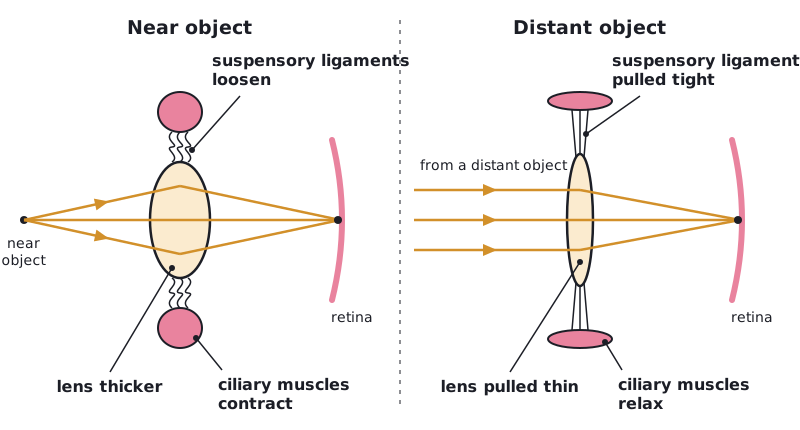
Accommodation is changing the shape of the lens to focus on near or distant objects. For a near object, the ciliary muscles contract, the suspensory ligaments slacken and the lens becomes thicker, so light is refracted more. For a distant object, the ciliary muscles relax, the ligaments are pulled tight and the lens becomes thinner, refracting light less.

Accommodation
Changing the shape of the lens to focus on near or distant objects.

The ciliary muscles form a ring around the lens. The lens is held in place by the suspensory ligaments, which join it to the ciliary muscles. When the ciliary muscles contract or relax, the tension in the suspensory ligaments changes. This changes the shape of the lens, so it refracts light by a different amount.

Focusing on near and distant objects
Near objectDistant object
Ciliary musclesContractRelax
Tension in suspensory ligamentsDecreases (ligaments slack)Increases (ligaments pulled tight)
Shape of lensThicker (more curved)Thinner (flatter)
Refraction of lightLight is refracted moreLight is refracted less
Two lens diagrams: for a near object the ciliary muscles contract, the suspensory ligaments loosen and the lens is thicker; for a distant object the ciliary muscles relax, the suspensory ligaments are pulled tight and the lens is pulled thin. In both, light rays focus on the retina. (opens full size in a new tab)
Accommodation. Near object: muscles contract, ligaments loosen, lens thicker. Distant object: muscles relax, ligaments tight, lens thin.
Common mistake:

For a near object the ciliary muscles contract and the ligaments go slack. Many students reverse this. Remember: contracted muscle, slack ligaments, fat lens.

Written and checked against the Cambridge IGCSE Biology (0610) specification · Updated October 2026

Frequently asked questions

How does the eye focus on near objects?

Supplement The eye focuses on near objects by accommodation. The ciliary muscles contract, so the tension in the suspensory ligaments decreases and they go slack. The lens becomes thicker and more curved, so it refracts light more and focuses the image on the retina. Remember: contracted muscle, slack ligaments, fat lens.

What does the cornea do?

The cornea refracts, or bends, light as it enters the eye. After the cornea, light passes through the pupil, and the lens focuses it on to the retina. The iris controls how much light enters. In exams use the exact verb: the cornea refracts light, while the lens focuses light.

Why does the pupil get smaller in bright light?

The pupil gets smaller in bright light to protect the retina from damage. This is the pupil reflex, an automatic response. Less light enters the eye when the pupil constricts. In the iris, the circular muscles contract and the radial muscles relax, which makes the pupil narrower. In dim light the reverse happens.

All 5 questions on Sense organs