
Investigating the factors that affect diffusionSpec 3.1.5
In short
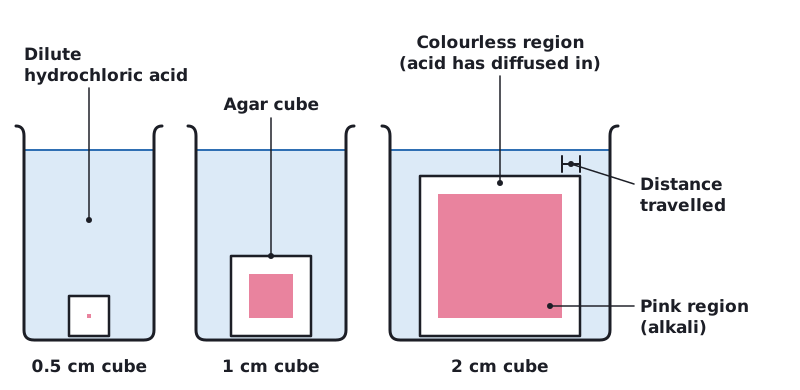
The rate of diffusion depends on four factors: surface area, temperature, concentration gradient and distance. Diffusion is faster with a larger surface area, a higher temperature, a steeper concentration gradient and a shorter distance. In agar cubes containing indicator placed in dilute acid, the smallest cube, with the largest surface area compared with its volume, loses its colour first.
You need to investigate four factors that affect the rate of diffusion: surface area, temperature, concentration gradient and distance.
| Factor | Effect on rate | Reason |
|---|---|---|
| Surface area | Larger surface area, faster diffusion | More particles can cross at the same time |
| Temperature | Higher temperature, faster diffusion | Particles have more kinetic energy and move faster |
| Concentration gradient | Steeper gradient, faster diffusion | A bigger difference in concentration gives a greater net movement of particles |
| Distance | Shorter distance, faster diffusion | Particles have less far to travel |
Investigate surface area using cubes of agar jelly containing indicator. Use phenolphthalein in dilute sodium hydroxide (pink in alkali) and place the cubes in dilute hydrochloric acid. The acid diffuses in and the pink colour disappears. Wear eye protection.
- Cut agar cubes of different sizes (for example 0.5 cm, 1 cm and 2 cm sides) with a scalpel on a tile.
- Put each cube in the same volume of dilute hydrochloric acid at the same temperature.
- Time how long each cube takes to turn colourless all the way through.
- Repeat each size and calculate a mean time.
- To test temperature, use the same size of cube in acid at different temperatures, for example 20, 30, 40 and 50 °C.
- Independent variable: cube size (or temperature, or acid concentration).
- Dependent variable: time taken to turn colourless.
- Control variables: volume and concentration of acid, temperature, how the cubes are cut and timed.
The smallest cube loses its colour first. Small cubes have a larger surface area compared with their volume, and the acid has a shorter distance to travel to the centre.
Surface area to volume ratio
Calculate the surface area to volume ratio of a 2 cm cube.
- Surface area = 6 × (2 × 2) = 24 cm².
- Volume = 2 × 2 × 2 = 8 cm³.
- Ratio = 24 ÷ 8 = 3.
Answer: 3 : 1 (a 1 cm cube has a ratio of 6 : 1, so it is larger and diffusion into it is faster).
 (opens full size in a new tab)
Quick check
Describe diffusion.
Show answer
The net movement of particles from a region of their higher concentration to a region of their lower concentration (i.e. down a concentration gradient), as a result of their random movement.
Where does the energy for diffusion come from?
Show answer
The kinetic energy of the random movement of molecules and ions.
Name two substances that move into or out of cells by diffusion.
Show answer
Any two from: oxygen, carbon dioxide, urea, digested food molecules.
Name the four factors you investigate that affect the rate of diffusion.
Show answer
Surface area, temperature, concentration gradient and distance.
Written and checked against the Cambridge IGCSE Biology (0610) specification · Updated October 2026