

Sex linkage and colour blindnessSpec 17.4.16, 17.4.17, 17.4.18
A sex-linked characteristic is a feature in which the gene responsible is located on a sex chromosome. This makes the characteristic more common in one sex than in the other.
Red-green colour blindness is an example. The gene is on the X chromosome and the allele for colour blindness is recessive. The Y chromosome does not carry this gene.
- Males (XY) have only one X chromosome, so one recessive allele is enough to make them colour blind.
- Females (XX) need two recessive alleles to be colour blind. With one, they are carriers and have normal colour vision.
- So colour blindness is more common in males than in females.
Write the allele letter straight after the X: XB is the normal allele and Xb is the colour blindness allele. Exam papers print the B or b as a small raised letter. The Y has no allele, so a male genotype is XB Y or Xb Y.
| XB (egg) | Xb (egg) | |
|---|---|---|
| XB (sperm) | XB XB normal female | XB Xb carrier female |
| Y (sperm) | XB Y normal male | Xb Y colour-blind male |
The probability that a son is colour blind is 1 in 2 (50%). None of the daughters is colour blind, but half are carriers. Phenotypic ratio: 2 normal females : 1 normal male : 1 colour-blind male.
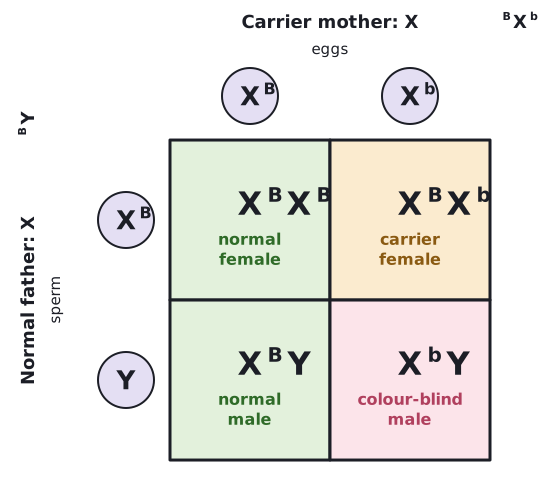 (opens full size in a new tab)
Always write sex-linked genotypes with X and Y and put the allele letter on the X. Write Xb Y, not bb, for a colour-blind male.
Quick check
Define phenotype.
Show answer
The observable features of an organism.
What is a heterozygous genotype?
Show answer
Two different alleles of a particular gene, for example Tt.
Two parents without a condition have a child with it. Is the allele dominant or recessive?
Show answer
Recessive, and both parents are heterozygous carriers.
Supplement Which genotype is used as the tester in a test cross?
Show answer
Homozygous recessive.
Supplement Why is red-green colour blindness more common in males?
Show answer
Males have one X chromosome, so one recessive allele is enough. Females need two.