
Single and double circulationSpec 9.1.1, 9.1.2, 9.1.3, 9.1.4
In short
The circulatory system is a system of blood vessels with a pump, the heart, and valves to ensure one-way flow of blood. In a fish's single circulation, blood passes through the heart once per circuit. In a mammal's double circulation it passes through twice, so blood is pumped again after the lungs and reaches the body at high pressure.
The circulatory system is a system of blood vessels with a pump and valves to ensure one-way flow of blood. The pump is the heart. The vessels are arteries, veins and capillaries. Valves stop blood flowing backwards.
Supplement (what this means)
Supplement: only for the Extended papers (2 and 4). Core students can skip it. What the labels meanSingle circulation of a fish
Supplement (what this means)
Supplement: only for the Extended papers (2 and 4). Core students can skip it. What the labels meanIn a fish the blood passes through the heart only once during each complete circuit of the body.
Supplement (what this means)
Supplement: only for the Extended papers (2 and 4). Core students can skip it. What the labels mean- The heart pumps deoxygenated blood to the gills.
- In the gill capillaries the blood picks up oxygen. Blood pressure falls because the capillaries are so narrow.
- The oxygenated blood flows on to the organs and muscles of the body, but at lower pressure.
- The blood returns to the heart.
Supplement (what this means)
Supplement: only for the Extended papers (2 and 4). Core students can skip it. What the labels meanDouble circulation of a mammal
Supplement (what this means)
Supplement: only for the Extended papers (2 and 4). Core students can skip it. What the labels meanIn a mammal the blood passes through the heart twice during each complete circuit of the body. There are two separate circuits.
Supplement (what this means)
Supplement: only for the Extended papers (2 and 4). Core students can skip it. What the labels mean- Pulmonary circulation: right side of the heart, then the lungs, then back to the left side of the heart.
- Systemic circulation: left side of the heart, then the rest of the body, then back to the right side of the heart.
Supplement (what this means)
Supplement: only for the Extended papers (2 and 4). Core students can skip it. What the labels mean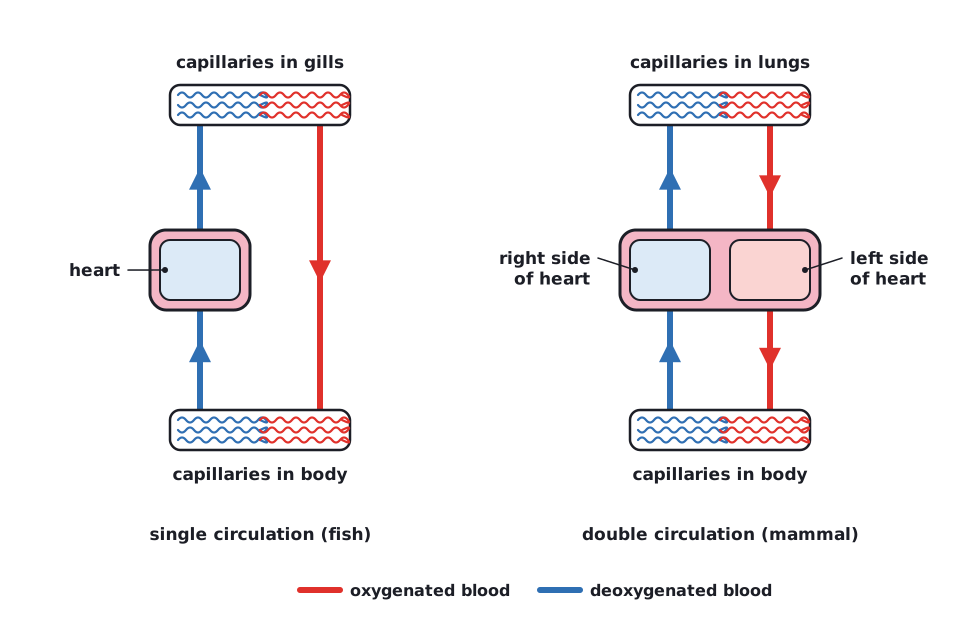 (opens full size in a new tab)
Supplement (what this means)
Supplement: only for the Extended papers (2 and 4). Core students can skip it. What the labels meanAdvantages of a double circulation
Supplement (what this means)
Supplement: only for the Extended papers (2 and 4). Core students can skip it. What the labels meanAfter blood has passed through the lung capillaries its pressure is low. In a double circulation it returns to the heart to be pumped again.
Supplement (what this means)
Supplement: only for the Extended papers (2 and 4). Core students can skip it. What the labels mean- Blood is pumped at high pressure to the body, so oxygen and glucose reach the tissues quickly.
- Blood pressure in the lungs can be kept lower, so the delicate lung capillaries are not damaged.
- Mammals have a high rate of respiration (for example, to keep their body temperature constant), so they need this fast supply of oxygen and glucose.
Supplement (what this means)
Supplement: only for the Extended papers (2 and 4). Core students can skip it. What the labels mean| Feature | Fish (single) | Mammal (double) |
|---|---|---|
| Times blood passes through the heart in one circuit | Once | Twice |
| Pressure of blood reaching the body organs | Low, as it has just passed through the gill capillaries | High, as it is pumped again after the lungs |
Supplement (what this means)
Supplement: only for the Extended papers (2 and 4). Core students can skip it. What the labels meanAlways say the blood returns to the heart before going to the body in a double circulation. That is the idea that earns the marks for the advantage.
Quick check
What is the circulatory system?
Show answer
A system of blood vessels with a pump and valves to ensure one-way flow of blood.
Supplement How many times does blood pass through the heart in one circuit of a fish?
Show answer
Once (single circulation).
Supplement Name the two circuits of a mammal's double circulation.
Show answer
Pulmonary (heart to lungs and back) and systemic (heart to body and back).
Supplement Give one advantage of a double circulation.
Show answer
Blood is returned to the heart and pumped to the body at high pressure, so substances are delivered faster.
Written and checked against the Cambridge IGCSE Biology (0610) specification · Updated October 2026