

Factors affecting the rate of transpirationSpec 8.3.3, 8.3.6
The rate of transpiration changes with the conditions around the plant. You must be able to describe the effects of temperature and wind speed.
| Factor | Effect on rate |
|---|---|
| Temperature | higher temperature gives a faster rate |
| Wind speed | higher wind speed gives a faster rate |
Supplement (what this means)
Supplement: only for the Extended papers (2 and 4). Core students can skip it. What the labels meanExplaining the effects of temperature, wind speed and humidity
Supplement (what this means)
Supplement: only for the Extended papers (2 and 4). Core students can skip it. What the labels mean- Temperature: a higher temperature gives water molecules more energy, so they evaporate from the mesophyll cells faster. Water vapour also diffuses faster.
- Wind speed: wind blows water vapour away from around the stomata. This keeps the concentration gradient between the air spaces and the outside air steep, so diffusion is faster.
- Humidity: higher humidity gives a slower rate. Humid air already contains a lot of water vapour, so the concentration gradient between the air spaces and the air outside is less steep and diffusion out of the leaf is slower. In dry air the gradient is steeper and transpiration is faster.
Measuring the rate: the potometer
A potometer measures how much water a cut shoot takes up. Most of the water taken up is lost by transpiration, so water uptake is used as an estimate of the rate of transpiration. As the shoot takes up water, an air bubble in the capillary tube moves along a scale.
- Cut a leafy shoot under water and fit it into the potometer, keeping the apparatus full of water with no air bubbles.
- Introduce an air bubble into the capillary tube and note its starting position.
- Change one factor, for example place a fan at different distances to vary wind speed, or use rooms or water baths at different temperatures.
- Measure the distance moved by the bubble in a set time.
- Repeat and calculate a mean. Keep everything else the same.
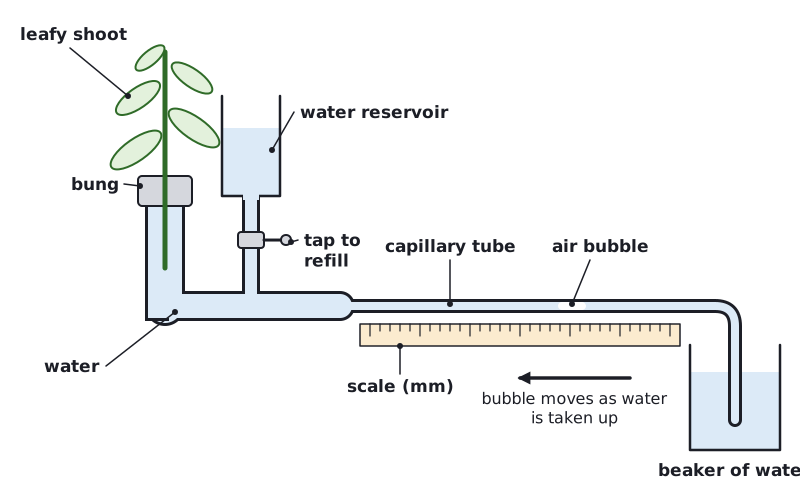 (opens full size in a new tab)
Calculating a rate
In a potometer, the air bubble moved 45 mm in 15 minutes. Calculate the rate of water uptake in mm / min.
- rate = distance ÷ time
- rate = 45 ÷ 15
Answer: 3 mm / min
Name the independent variable (for example wind speed), the dependent variable (distance moved by the bubble in a set time) and at least two controlled variables (such as the same shoot, temperature and light). Repeat the experiment for reliability.