

Inspired and expired airSpec 11.1.3, 11.1.4, 11.1.9
Inspired air is the air you breathe in. Expired air is the air you breathe out. Their composition is different because of what happens in the body between breathing in and breathing out.
| Gas | Inspired air | Expired air |
|---|---|---|
| Oxygen | About 21% | About 16% (less) |
| Carbon dioxide | About 0.04% (very little) | About 4% (more) |
| Water vapour | Variable, usually low | Higher (saturated) |
Describe differences using comparison words: expired air has less oxygen, more carbon dioxide and more water vapour than inspired air. Only quote percentages if the question gives them or asks for them.
Investigating the difference using limewater
Limewater is a test for carbon dioxide. It turns from colourless to cloudy (milky) when carbon dioxide is bubbled through it. The more carbon dioxide there is, the faster it goes cloudy.
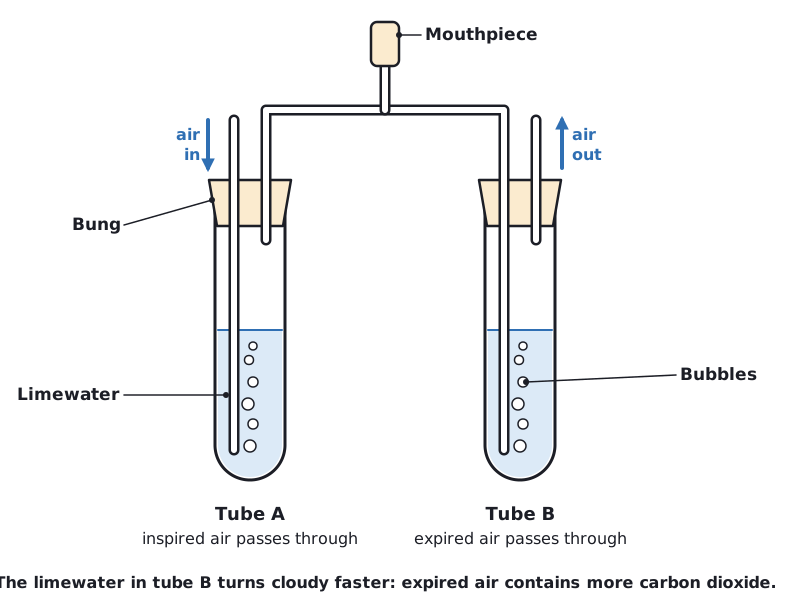
- Set up two boiling tubes, each containing the same volume of limewater, joined by tubing and glass tubes so that one is used for breathing in through and the other for breathing out through.
- Breathe in and out through the mouthpiece several times. Air you breathe in passes through the first tube of limewater. Air you breathe out passes through the second tube.
- Compare how quickly the limewater in each tube turns cloudy.
 (opens full size in a new tab)
Keep the volume of limewater, the size of the tubes and the number of breaths the same in both tubes so that it is a fair test. Wear eye protection and take care not to suck limewater into the mouth.
Result: the limewater in the tube for expired air turns cloudy much faster than the limewater in the tube for inspired air. This shows that expired air contains more carbon dioxide.
Supplement (what this means)
Supplement: only for the Extended papers (2 and 4). Core students can skip it. What the labels meanExplaining the differences
Supplement (what this means)
Supplement: only for the Extended papers (2 and 4). Core students can skip it. What the labels mean- Less oxygen: oxygen is absorbed into the blood at the alveoli, and the cells of the body use it in aerobic respiration. Only some of the oxygen is removed, so expired air still contains a lot.
- More carbon dioxide: carbon dioxide is produced by the cells in respiration, carried to the lungs in the blood and diffuses into the alveoli.
- More water vapour: water evaporates from the moist lining of the alveoli into the air in the alveoli.