

Cells, tissues, organs and organ systemsSpec 2.1.7
Living things are built up in levels: cell, tissue, organ, organ system and organism. Each level is made from the one below it.
- Cell
- The basic unit of living things; cells are the building blocks of all organisms.
- Tissue
- A group of cells with similar structures, working together to perform a shared function.
- Organ
- A structure made up of a group of tissues, working together to perform specific functions.
- Organ system
- A group of organs with related functions, working together to perform body functions.
- Organism
- A whole living thing. It may be a single cell (e.g. a bacterium) or many cells organised into tissues, organs and organ systems that work together.
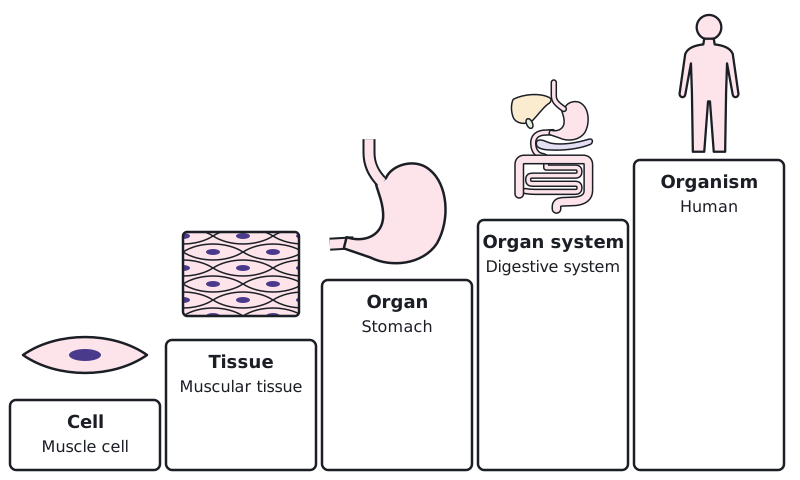 (opens full size in a new tab)
Give an example with each definition. Animal: muscle cells make muscle tissue; the stomach is an organ; the digestive system is an organ system; a human is an organism. Plant: palisade mesophyll cells make palisade mesophyll tissue; the leaf is an organ.
Quick check
Name three structures found in plant cells but not in animal cells.
Show answer
Cell wall, chloroplasts and a large vacuole.
Where is the DNA in a bacterial cell?
Show answer
Circular DNA, free in the cytoplasm; there is no nucleus.
How are new cells produced?
Show answer
By division of existing cells.
Which specialised cell transports oxygen?
Show answer
The red blood cell.
Put in order, smallest first: organ, cell, organism, tissue, organ system.
Show answer
Cell, tissue, organ, organ system, organism.