
Implantation, the fetus and the placentaSpec 16.4.7, 16.4.8, 16.4.9, 16.4.10
In short
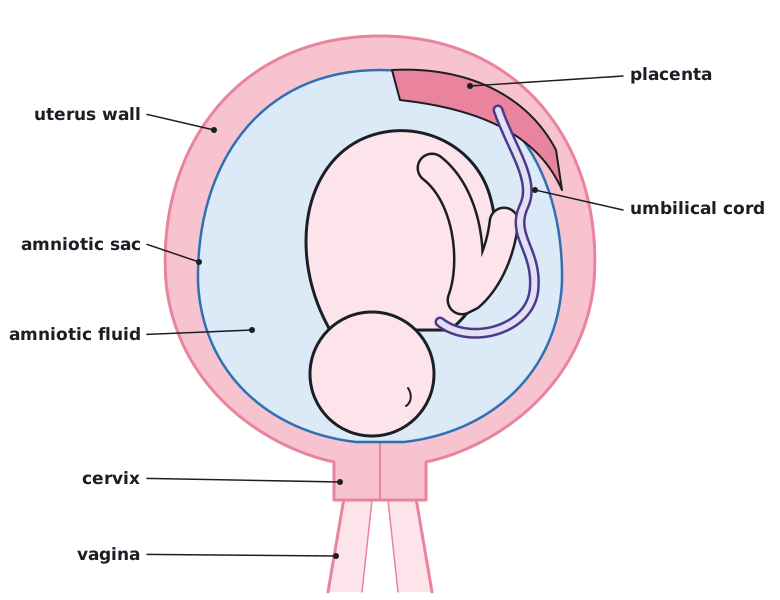
Implantation is when the embryo, a ball of cells, settles into the lining of the uterus; it then develops into a fetus. The placenta is where substances are exchanged between the mother's and the fetus's blood without them mixing. The umbilical cord connects the fetus to the placenta, and amniotic fluid protects the fetus from knocks.
After fertilisation, the zygote divides to form an embryo. The embryo is a ball of cells. It travels along the oviduct to the uterus and implants into the lining of the uterus. It then develops into a fetus.
| Structure | Function |
|---|---|
| Placenta | Disc of tissue attached to the uterus wall where substances are exchanged between the mother's blood and the fetus's blood |
| Umbilical cord | Connects the fetus to the placenta. It contains blood vessels that carry blood between the fetus and the placenta |
| Amniotic sac | Membrane that surrounds the fetus and holds the amniotic fluid |
| Amniotic fluid | Protects the fetus from knocks and bumps (it acts as a shock absorber) |
 (opens full size in a new tab)
Supplement (what this means)
Supplement: only for the Extended papers (2 and 4). Core students can skip it. What the labels meanExchange at the placenta
Supplement (what this means)
Supplement: only for the Extended papers (2 and 4). Core students can skip it. What the labels meanThe blood of the mother and the blood of the fetus flow close together in the placenta, but they do not mix. Substances pass between them across a thin barrier, mainly by diffusion. The umbilical cord carries the fetus's blood to and from the placenta.
Supplement (what this means)
Supplement: only for the Extended papers (2 and 4). Core students can skip it. What the labels mean| From mother to fetus | From fetus to mother |
|---|---|
| Dissolved nutrients (for example glucose and amino acids) | Excretory products (for example urea) |
| Oxygen | Carbon dioxide |
Supplement (what this means)
Supplement: only for the Extended papers (2 and 4). Core students can skip it. What the labels mean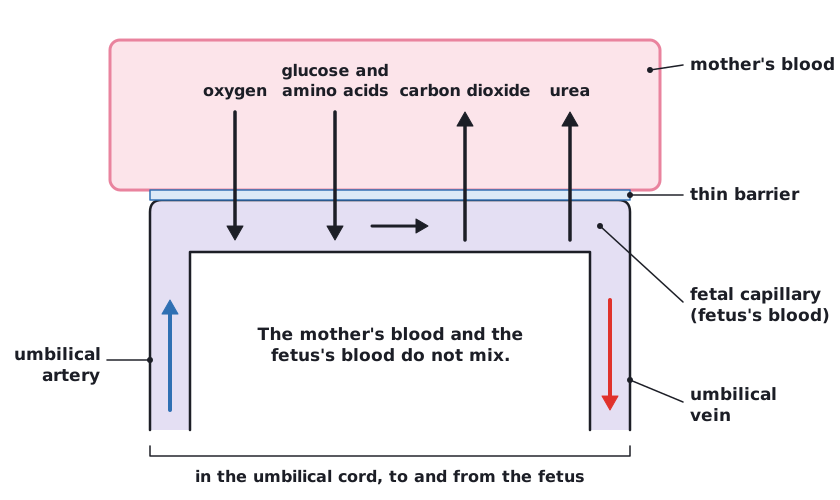 (opens full size in a new tab)
Supplement (what this means)
Supplement: only for the Extended papers (2 and 4). Core students can skip it. What the labels meanSome pathogens (for example some viruses) and toxins (for example some drugs and alcohol) can pass across the placenta from the mother's blood into the fetus's blood and may harm the fetus.
Supplement (what this means)
Supplement: only for the Extended papers (2 and 4). Core students can skip it. What the labels meanThe mother's blood does not flow into the fetus. The two bloods stay separate, and substances cross the placenta between them.
Quick check
Which part of the male reproductive system carries sperm from the testes to the urethra?
Show answer
The sperm duct.
Name the part of the female system where the fetus develops.
Show answer
The uterus.
What happens at fertilisation?
Show answer
The nucleus of a sperm fuses with the nucleus of an egg cell.
State the function of amniotic fluid.
Show answer
It protects the fetus from knocks and bumps.
Supplement Name two types of substance that can cross the placenta and harm a fetus.
Show answer
Pathogens and toxins.
Written and checked against the Cambridge IGCSE Biology (0610) specification · Updated October 2026