
Growth in animals and plantsSpec 2.5
In short
Growth is an increase in the size or mass of an organism. Animals grow by cell division and differentiation. Plants grow by cell division, elongation and differentiation. In elongation, plant cells made by mitosis get longer, mostly by taking in water, which is what makes plants grow taller and roots grow longer.
Growth is an increase in the size or mass of an organism. It involves different processes in animals and plants.
| Animals | Plants | |
|---|---|---|
| Cell division | Yes, by mitosis | Yes, by mitosis |
| Differentiation | Yes | Yes |
| Elongation | No | Yes: cells get longer |
In animals, growth happens by cell division and differentiation. New cells are made by mitosis and then become specialised for particular jobs.
In plants, growth happens by cell division, elongation and differentiation. Cells made by mitosis then get longer (elongate), mostly by taking in water so that the cell expands. After elongating, they differentiate. Elongation is what makes plants grow taller and roots grow longer.
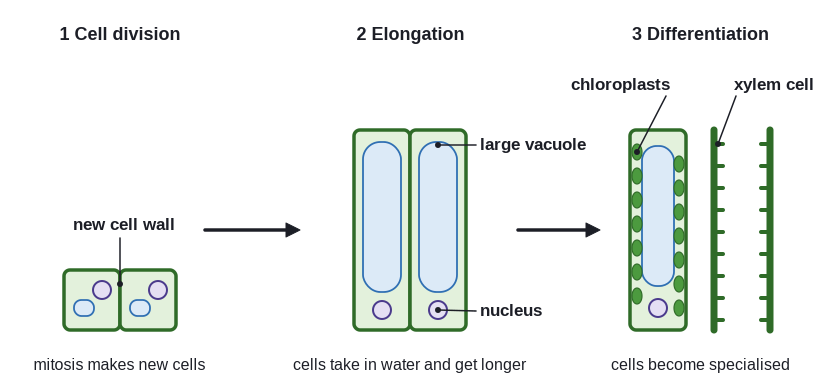 (opens full size in a new tab)
If a question asks how plants grow, name all three processes. Animals do not grow by elongation.
Written and checked against the Edexcel GCSE Biology (1BI0) specification · Updated October 2026