
Active transportSpec 1.15
In short
Active transport is the movement of substances from a more dilute solution to a more concentrated solution, against a concentration gradient, using energy from respiration. It lets cells take in substances that are in short supply outside the cell. For example, root hair cells take in mineral ions from the soil even when the concentration inside the cell is higher.
Active transport is the movement of substances from a more dilute solution to a more concentrated solution, which is against a concentration gradient. It needs energy from respiration.
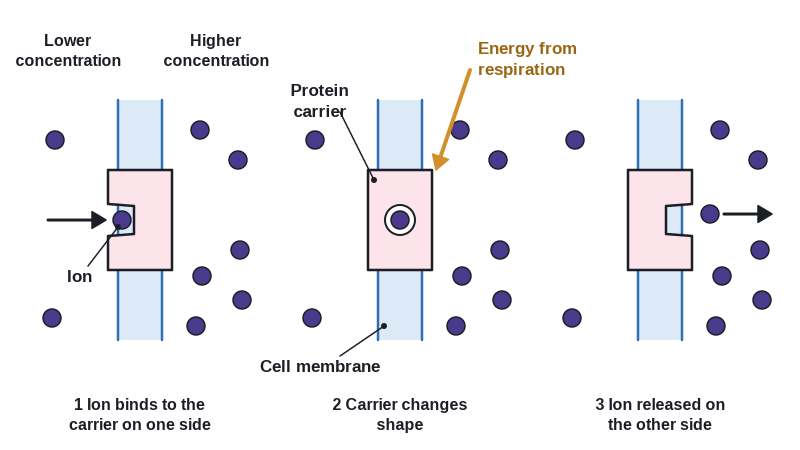 (opens full size in a new tab)
Active transport allows cells to take in substances they need even when they are in short supply outside the cell. For example, root hair cells take in mineral ions from the soil when the concentration of the ions is higher inside the cell than in the soil.
| What moves | Direction | Energy from respiration? | |
|---|---|---|---|
| Diffusion | Particles, such as oxygen and carbon dioxide | High to low concentration | No |
| Osmosis | Water only, through a partially permeable membrane | Dilute to concentrated solution | No |
| Active transport | Substances such as mineral ions | Low to high concentration, against the gradient | Yes |
Where active transport is used
- Root hair cells take in mineral ions from the soil by active transport, using energy from respiration.
Triple only (what this means)
Triple only: only in Triple Biology. Combined Science students can skip it. What the labels mean- Kidney tubules reabsorb all the glucose back into the blood by active transport.
Exam-style question
Roots in waterlogged soil
When soil is waterlogged, there is very little oxygen around the roots. Explain why the roots then take in fewer mineral ions. [3]
- Mineral ions are taken in by active transport, against the concentration gradient (1 mark).
- Active transport needs energy from respiration (1 mark).
- With less oxygen, the root cells carry out less aerobic respiration, so less energy is released for active transport (1 mark).
Answer: Less oxygen means less respiration, so less energy is available for the active transport of mineral ions.
Common wrong answers
- Active transport moves substances down the gradient. Wrong: it moves them from a more dilute to a more concentrated solution, against the gradient.
- Active transport makes energy. It uses energy released by respiration. Energy is never 'made'.
- Osmosis and diffusion need energy too. They are passive. Only active transport needs energy from respiration.
Written and checked against the Edexcel GCSE Biology (1BI0) specification · Updated October 2026