

Fossil evidence for human evolutionSpec 4.4
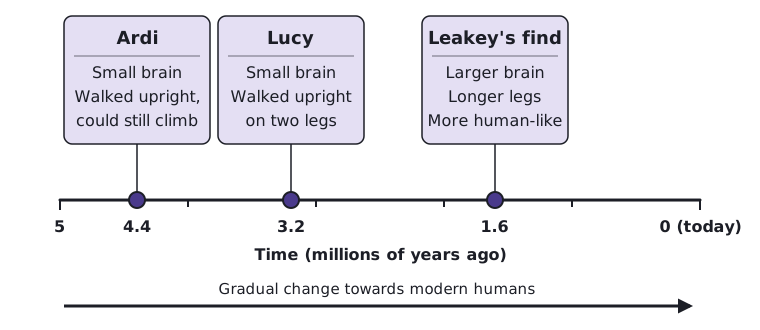
Fossils are the preserved remains or traces of organisms that lived long ago. By comparing fossils of different ages, scientists can see how early human ancestors changed over time. You need to know three important discoveries.
| Fossil | Age | What it shows |
|---|---|---|
| Ardi | 4.4 million years ago | Partial skeleton. A small brain and long arms. Could walk upright, but had a grasping big toe so could still climb trees. |
| Lucy | 3.2 million years ago | Partial skeleton. Walked upright on two legs, with feet more like a human's, but still a small brain and some ape-like features. |
| Fossils found by Richard Leakey and his team | 1.6 million years ago | Many fossils, including a nearly complete skeleton. A larger brain, longer legs and a body shape much more like a modern human. |
Taken together, the fossils show a gradual change from ape-like ancestors towards modern humans. Walking upright came first, and larger brains came later.
The evidence has limits. Fossils are rare because most dead organisms decay before fossilising, and many fossils are incomplete. This is why scientists sometimes disagree, and why new discoveries can change ideas about human evolution.
Working with large time spans
Ardi lived 4.4 million years ago and Lucy lived 3.2 million years ago. Write 4.4 million in standard form, and find how many years separate the two fossils.
- 4.4 million = 4 400 000 = 4.4 × 10⁶ years
- Difference = 4.4 − 3.2 = 1.2 million years
- 1.2 million = 1.2 × 10⁶ years
Answer: 4.4 × 10⁶ years; the fossils are 1.2 × 10⁶ years apart.
 Tap to enlarge
Stone toolsSpec 4.5
Early humans made tools from stone. Stone tools survive for a very long time, so they give evidence about how early humans lived and how their skills developed.
Development of stone tools over time
- The oldest tools are very simple, such as stones with a few chips knocked off to make a sharp edge.
- Over time tools became more complex and better made: more carefully shaped and more specialised for different jobs.
- This suggests that early humans developed greater skill and intelligence, which fits with fossil evidence of larger brains.
Dating stone tools
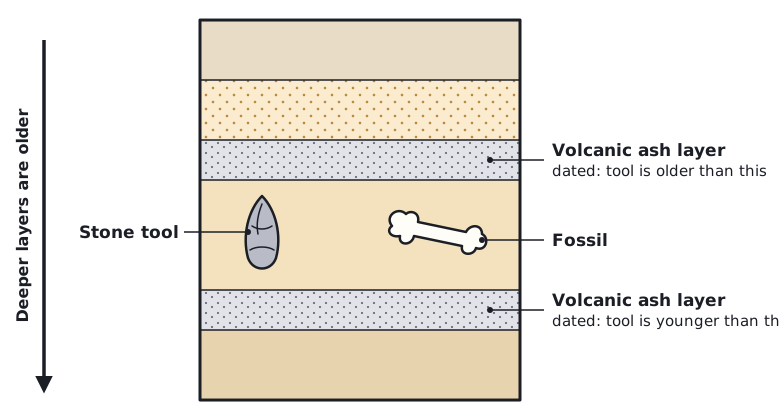
Scientists can date stone tools from their environment. A tool is found in a layer of rock or sediment. The age of that layer, or of materials found with the tool such as volcanic ash, can be worked out. The tool is then taken to be about the same age as the layer it was found in. Layers are laid down one on top of another, so deeper layers are usually older.
 Tap to enlarge
The pentadactyl limbSpec 4.6BTriple only
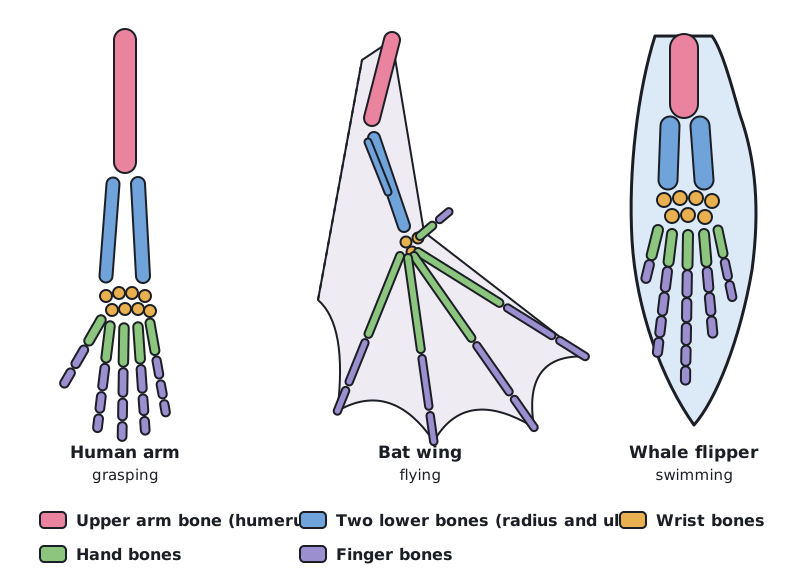
The pentadactyl limb is a limb with five digits. The same basic pattern of bones is found in the limbs of many vertebrates, including humans, bats, whales and frogs.
Although these limbs do different jobs (grasping, flying, swimming, jumping), they have the same basic arrangement of bones: one upper bone, two lower bones, then wrist, hand and finger bones. The size and shape of the bones differ to suit each function.
This provides evidence for evolution. The similar bone structure suggests the animals share a common ancestor, and natural selection has adapted the limb to different ways of life over time. If each animal had evolved separately, there would be no reason for the same bone pattern.
 Tap to enlarge
Five kingdoms and three domainsSpec 4.7
Living things were traditionally sorted into five kingdoms: animals, plants, fungi, protists and prokaryotes. This was based on the structure and features of organisms that could be observed.
Improved methods of genetic analysis (comparing the genetic material of different organisms) showed that the prokaryotes are not all closely related. This led to a new system of three domains, which sits above the kingdoms.
| Domain | Organisms |
|---|---|
| Archaea | Prokaryotes that are genetically very different from bacteria |
| Bacteria | 'True' bacteria (prokaryotes) |
| Eukarya | Organisms with a nucleus: protists, fungi, plants and animals |
Quick check
Which is older, Ardi or Lucy?
Show answer
Ardi (4.4 million years ago; Lucy is 3.2 million years ago).
How are stone tools dated from their environment?
Show answer
By finding the age of the rock layer, or materials found with them, in which they were buried.
Name the five kingdoms.
Show answer
Animals, plants, fungi, protists and prokaryotes.
What are the three domains?
Show answer
Archaea, Bacteria and Eukarya.