

The urinary systemSpec 7.18B
The urinary system removes waste from the blood and gets rid of it as urine.
| Part | Function |
|---|---|
| Kidneys | Filter the blood and make urine |
| Renal artery | Brings blood to the kidney |
| Renal vein | Takes blood away from the kidney |
| Ureters | Tubes that carry urine from the kidneys to the bladder |
| Bladder | Stores urine |
| Urethra | Tube that carries urine out of the body |
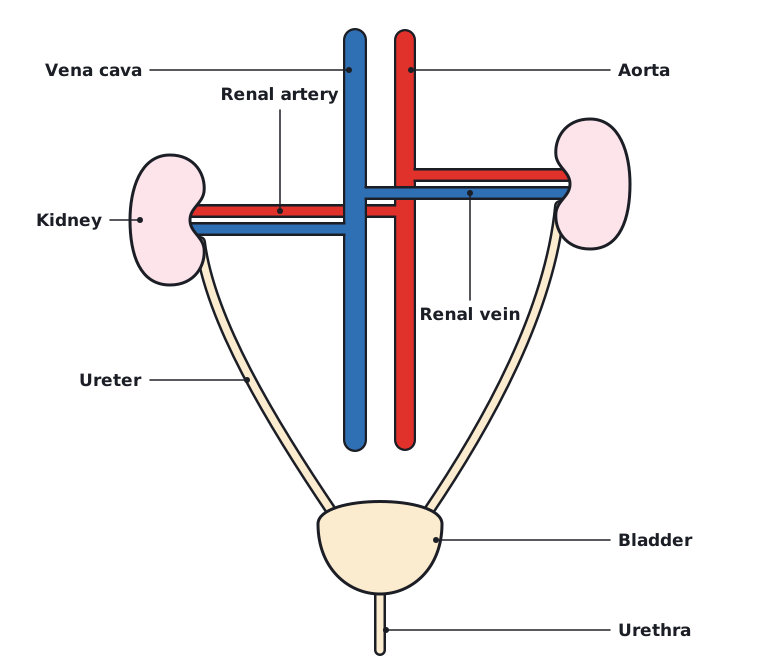 Tap to enlarge
UreaSpec 7.22B
The body cannot store excess amino acids. They are broken down in the liver, and urea is produced. Urea is a waste substance. It is carried in the blood to the kidneys and removed in the urine.
The nephron: filtering and reabsorptionSpec 7.19B
Each kidney contains many tiny tubes called nephrons. The nephron filters the blood and forms urine. Blood enters a knot of capillaries, the glomerulus, which sits inside a cup-shaped Bowman's capsule.
- Filtration: blood in the glomerulus is at high pressure. Small molecules such as water, glucose, urea and ions are forced out into the Bowman's capsule. Large molecules such as proteins, and blood cells, stay in the blood.
- Selective reabsorption of glucose: in the first part of the tubule, all the glucose is reabsorbed back into the blood by active transport, which uses energy from respiration.
- Reabsorption of water: as the filtrate passes along the loop of Henle and the collecting duct, water is reabsorbed back into the blood. How much depends on the body's needs.
- What is left, which is urea, excess ions and water, is urine. It passes to the ureter.
| Substance | Filtered at the glomerulus? | In urine? |
|---|---|---|
| Water | Yes | Yes, the amount that is not reabsorbed |
| Glucose | Yes | No, all reabsorbed |
| Urea | Yes | Yes |
| Proteins and blood cells | No | No |
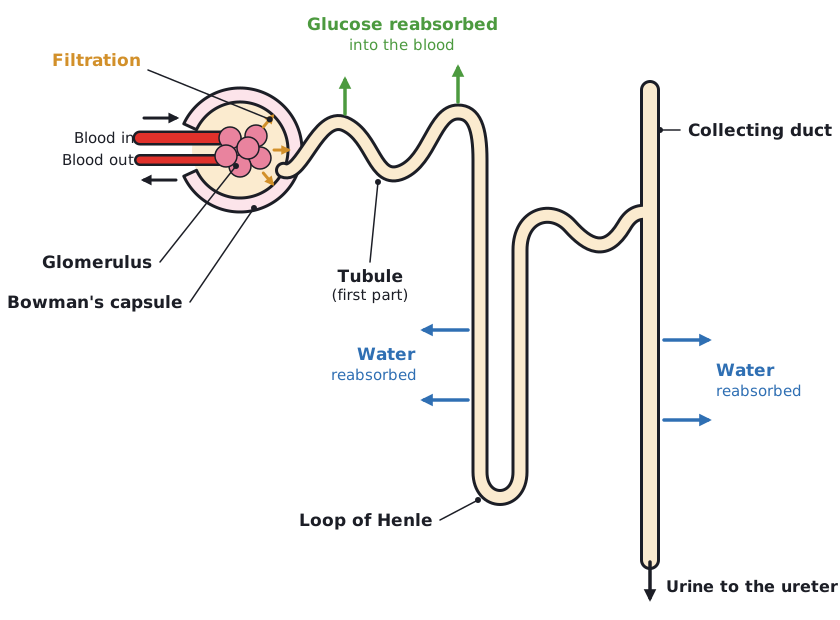 Tap to enlarge
ADH and the collecting ductSpec 7.20B
ADH is released by the pituitary gland. It controls how much water is reabsorbed in the kidney, which keeps the water content of the blood steady (osmoregulation). ADH changes the permeability of the collecting duct.
| Blood water content too low | Blood water content too high | |
|---|---|---|
| ADH released | More | Less |
| Collecting duct | More permeable to water | Less permeable to water |
| Water reabsorbed into blood | More | Less |
| Urine | Small volume, concentrated | Large volume, dilute |
| Blood water content | Rises back to normal | Falls back to normal |
Treating kidney failureSpec 7.21B
If the kidneys fail, waste substances such as urea build up in the blood. There are two treatments: kidney dialysis and organ donation (a kidney transplant).
Kidney dialysis
- The patient's blood flows through a dialysis machine, separated from dialysis fluid by a partially permeable membrane.
- Urea and excess ions and water pass out of the blood into the dialysis fluid, which is changed to keep the concentration gradient.
- The dialysis fluid has the same concentration of glucose and ions as healthy blood, so useful substances are not lost.
- The cleaned blood is returned to the patient.
Kidney transplant
A healthy kidney from a donor is placed in the patient. The donor kidney must be a good tissue match, and the patient takes drugs so the immune system does not reject it.
| Dialysis | Transplant | |
|---|---|---|
| Advantage | Available straight away | No regular treatment needed once it works |
| Disadvantage | Takes several hours, several times a week | Few donors, and the kidney may be rejected |
Quick check
Which tube carries urine from the bladder out of the body?
Show answer
The urethra.
Where is urea produced and from what?
Show answer
In the liver, from the breakdown of excess amino acids.
What happens to glucose in the nephron?
Show answer
It is all reabsorbed into the blood.
What does ADH do to the collecting duct? (Higher)
Show answer
It makes it more permeable to water, so more water is reabsorbed.
Give one treatment for kidney failure.
Show answer
Kidney dialysis or a kidney transplant from a donor.