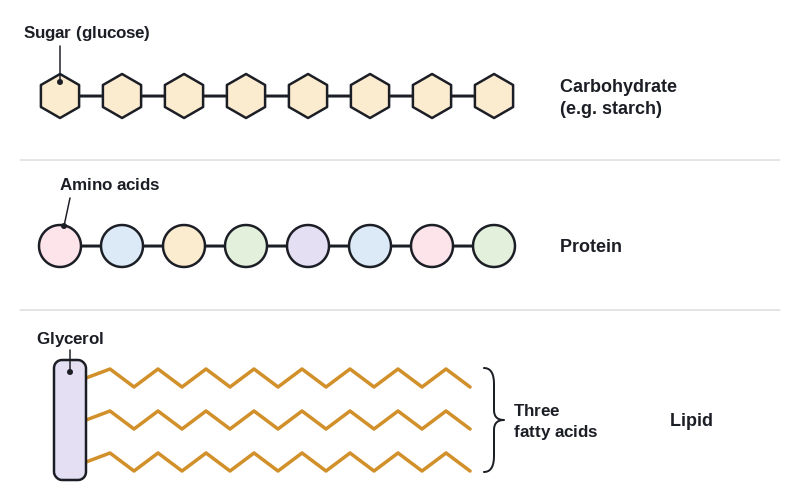
Enzymes are biological catalysts that speed up reactions in cells, which would otherwise be far too slow to keep us alive. They are needed to build and break down large molecules: carbohydrates are made from and broken into sugars, proteins into amino acids, and lipids into fatty acids and glycerol. Different enzymes catalyse each reaction, because enzymes are specific.
Chemical reactions in living things would be far too slow to keep us alive without enzymes. Enzymes are biological catalysts that speed up reactions in cells. They are needed both to build large molecules and to break them down.
Different enzymes catalyse each of these reactions, because enzymes are specific. Breaking down large molecules into small ones is a vital job, and so is building the carbohydrates, proteins and lipids the body needs.
Exam tip:
If asked what a catalyst does, say it speeds up a reaction and is not used up.
Written and checked against the Edexcel GCSE Biology (1BI0) specification · Updated October 2026
Frequently asked questions
Why are enzymes important in the body?
Enzymes are important because chemical reactions in living things would be far too slow to keep us alive without them. As biological catalysts, they speed up reactions in cells. They are needed both to break down large molecules such as proteins, carbohydrates and lipids, and to build them up from smaller molecules.
What are carbohydrates, proteins and lipids broken down into?
Carbohydrates are broken down into sugars, proteins into amino acids, and lipids into fatty acids and glycerol. Each reaction is catalysed by a different enzyme, because enzymes are specific. The same small molecules are also used to synthesise the large carbohydrates, proteins and lipids that the body needs.
How do you test for protein in food?
Triple only To test for protein, add biuret reagent to a liquid sample of the food and mix. If protein is present, the colour changes from blue to purple (lilac). If there is no protein, it stays blue. Solid food is first crushed with a little water. Always wear eye protection during food tests.

 (opens full size in a new tab)