

Exchange surfaces, transport systems and surface area : volume ratioSpec 8.2
The surface area : volume ratio tells you how much surface an organism has compared with its size. The bigger the organism, the smaller this ratio becomes.
surface area : volume ratio = surface area ÷ volume
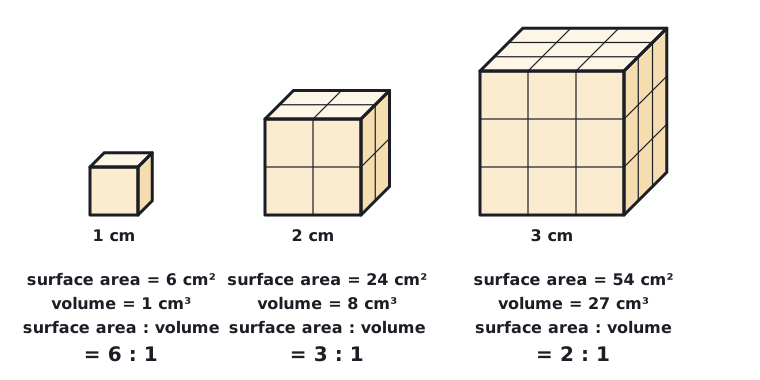
Surface area : volume ratio of a cube
A cube-shaped block of tissue has sides of 3 cm. Calculate its surface area : volume ratio.
- A cube has 6 faces. Area of one face = 3 × 3 = 9 cm².
- Surface area = 6 × 9 = 54 cm².
- Volume = 3 × 3 × 3 = 27 cm³.
- Ratio = 54 : 27. Divide both sides by 27.
Answer: 2 : 1
| Side of cube | Surface area | Volume | Surface area : volume |
|---|---|---|---|
| 1 cm | 6 cm² | 1 cm³ | 6 : 1 |
| 2 cm | 24 cm² | 8 cm³ | 3 : 1 |
| 3 cm | 54 cm² | 27 cm³ | 2 : 1 |
Single-celled and multicellular organisms
- A single-celled organism has a large surface area : volume ratio. Substances only have a short distance to diffuse, so diffusion across the surface is fast enough.
- A multicellular organism has a small surface area : volume ratio. Many cells are deep inside the body, so the diffusion distance is long and diffusion across the body surface is far too slow.
Multicellular organisms therefore need two things. An exchange surface has a large surface area so that enough oxygen can enter and enough carbon dioxide can leave. A transport system (the circulatory system in humans) then carries substances between the exchange surface and all the cells in the body.
 Tap to enlarge