
Calculating cross-sectional areasSpec 5.19B
In short
The area of a clear zone or bacterial colony is calculated with the equation for the area of a circle, area = πr², because they are roughly circular. The radius, r, is half the diameter, so measure the diameter, halve it, square it and multiply by π. A clear zone 14 mm across has an area of about 154 mm².
Clear zones and bacterial colonies are roughly circular, so their area is calculated using the equation for the area of a circle. A larger area means a bigger effect (for a clear zone) or more growth (for a culture).
The radius, r, is half the diameter. Measure the diameter across the middle of the zone, halve it, then square it and multiply by π.
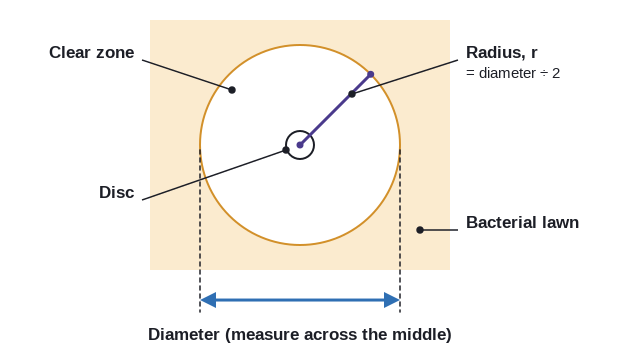 (opens full size in a new tab)
Area of a clear zone
The clear zone around a disc soaked in antiseptic has a diameter of 14 mm. Calculate the area of the clear zone. Use π = 3.14.
- radius = 14 ÷ 2 = 7 mm
- area = πr² = 3.14 × 7 × 7
- area = 3.14 × 49 = 153.86 mm²
Answer: About 154 mm²
A very common slip is to use the diameter instead of the radius. Halve the diameter first, and give your answer in mm² (or cm²).
Written and checked against the Edexcel GCSE Biology (1BI0) specification · Updated October 2026