

Insulin and blood glucoseSpec 7.13
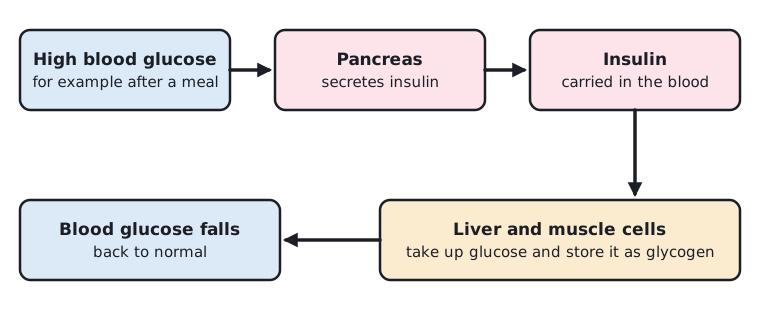
Blood glucose concentration must stay steady. It rises after a meal. The pancreas detects this and secretes the hormone insulin into the blood.
- Blood glucose concentration rises after a meal.
- The pancreas secretes insulin into the blood.
- Insulin makes cells take up glucose from the blood. In the liver and muscles, glucose is converted into glycogen for storage.
- Blood glucose concentration falls back to normal.
 Tap to enlarge
GlucagonSpec 7.14Higher tier
If blood glucose concentration falls too low, for example between meals or during exercise, the pancreas secretes glucagon instead.
- Blood glucose concentration falls.
- The pancreas secretes glucagon into the blood.
- Glucagon acts on the liver. The liver changes glycogen into glucose.
- Glucose is released into the blood, so blood glucose concentration rises back to normal.
| Insulin | Glucagon | |
|---|---|---|
| Released when | Blood glucose is too high | Blood glucose is too low |
| Acts on | Liver and other cells | Liver |
| Effect | Glucose into cells, glucose to glycogen | Glycogen to glucose |
| Result | Blood glucose falls | Blood glucose rises |
Insulin and glucagon work against each other. This is negative feedback, and it keeps blood glucose concentration close to normal.
Type 1 diabetesSpec 7.15
In type 1 diabetes, the pancreas does not produce enough insulin. Without insulin, body cells do not take up enough glucose from the blood. After a meal, blood glucose concentration rises and stays too high.
It is controlled by:
- injections of insulin, usually around meals
- monitoring blood glucose concentration
- controlling the amount of carbohydrate in the diet
Suggested practical: sugar in simulated urine
Urine from a healthy person contains no glucose. Glucose in urine suggests that blood glucose concentration is too high, as in untreated diabetes.
- Put a sample of simulated urine in a test tube.
- Add Benedict's solution.
- Heat the tube in a hot water bath for a few minutes.
- Record the colour. Blue means no sugar. Green, yellow, orange and brick red mean more and more sugar.
Type 2 diabetesSpec 7.16
In type 2 diabetes, the body cells no longer respond properly to insulin. Blood glucose concentration stays too high. It is linked to being overweight or obese.
It is controlled by:
- a carefully controlled diet, for example less sugar and refined carbohydrate
- regular exercise
- losing weight if overweight
- some people also need medication or insulin
| Type 1 | Type 2 | |
|---|---|---|
| Cause | Pancreas does not produce enough insulin | Cells no longer respond to insulin |
| Control | Insulin injections, diet and monitoring | Diet, exercise and weight loss, sometimes medication |
Body mass, BMI and type 2 diabetesSpec 7.17
There is a correlation between body mass and type 2 diabetes. In general, the higher the body mass, the greater the chance of developing it. You need to be able to calculate and interpret two measurements.
A higher waist:hip ratio means more fat is stored around the waist, which is linked to a higher risk of type 2 diabetes.
Calculating BMI and waist:hip ratio
A man has a mass of 85 kg and a height of 1.70 m. His waist is 102 cm and his hips are 96 cm. Calculate his BMI to 1 decimal place and his waist:hip ratio to 2 decimal places.
- Square the height: 1.70 × 1.70 = 2.89
- BMI = 85 ÷ 2.89 = 29.41
- Waist:hip ratio = 102 ÷ 96 = 1.0625
Answer: BMI = 29.4 and waist:hip ratio = 1.06
Evaluating the correlation
- A correlation shows that two things change together. It does not prove one causes the other.
- Other factors, such as diet, exercise and age, may also affect the risk.
- BMI does not show whether mass is fat or muscle, so a very muscular person can have a high BMI. The waist:hip ratio gives extra information about where fat is stored.
Quick check
Which organ makes insulin and which organ stores glycogen?
Show answer
The pancreas makes insulin. The liver stores glycogen.
What does glucagon do? (Higher)
Show answer
It makes the liver change glycogen into glucose, so blood glucose concentration rises.
State the cause of type 1 diabetes.
Show answer
The pancreas does not produce enough insulin.
State the cause of type 2 diabetes.
Show answer
Body cells no longer respond to insulin.
Write the BMI equation.
Show answer
BMI = mass (kg) ÷ height (m)².