

Photosynthetic organisms as producersSpec 6.1
Plants and algae carry out photosynthesis. They use light energy to make glucose from simple inorganic substances, so they do not need to eat other organisms.
This makes photosynthetic organisms the main producers of food and therefore of biomass. Biomass is the mass of living material. The glucose a plant makes is used to build new cells, so it becomes part of the plant's biomass.
Every food chain starts with a producer. Animals cannot make their own food, so they get their biomass, and the energy stored in it, by eating plants or algae, or by eating other animals that have eaten them.
- Producer
- An organism that makes its own food. Photosynthetic organisms (plants and algae) are the main producers of food and biomass.
- Biomass
- The mass of living material, which in a plant is made from the glucose it produces by photosynthesis.
The photosynthesis reactionSpec 6.2
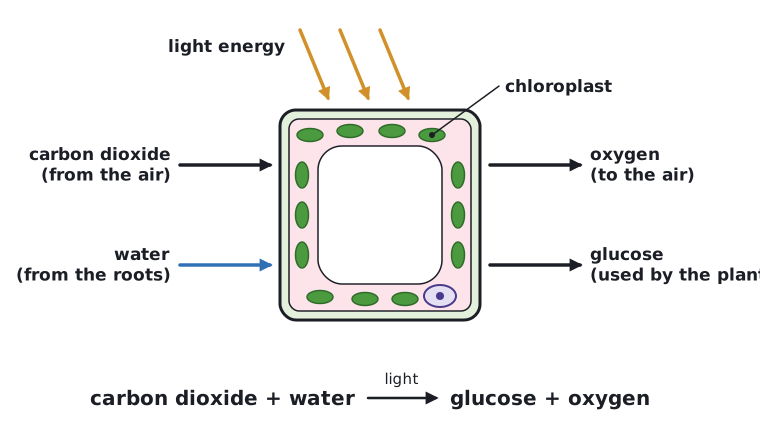
Photosynthesis in plants and algae is an endothermic reaction. This means it takes in energy from the surroundings. The energy comes from light, which is absorbed by the green pigment chlorophyll in the chloroplasts.
The light energy is used to react carbon dioxide and water to produce glucose and oxygen.
| Substance | Reactant or product | Source or fate |
|---|---|---|
| Carbon dioxide | Reactant | Diffuses into the leaf from the air |
| Water | Reactant | Absorbed from the soil by the roots and carried to the leaf in the xylem |
| Glucose | Product | Used for respiration, or to build new plant material (biomass) |
| Oxygen | Product | Diffuses out of the leaf into the air |
 Tap to enlarge
Limiting factorsSpec 6.3
A limiting factor is something that is in short supply, so it stops the rate of a process from going any faster. The rate of photosynthesis can be limited by temperature, light intensity and carbon dioxide concentration.
| Factor | Effect on rate | Why |
|---|---|---|
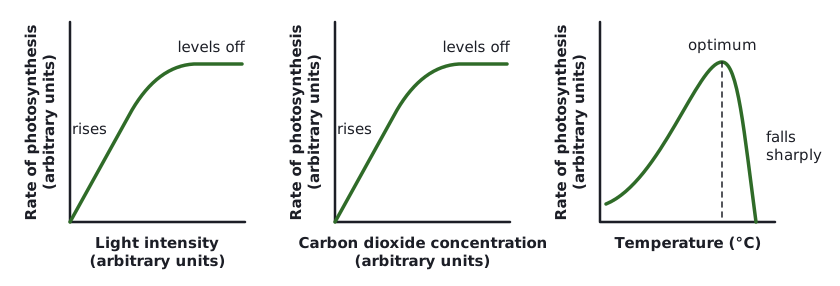
| Light intensity | Rate increases as light intensity increases, then levels off | Light provides the energy for the reaction. At low light, the amount of light limits the rate. At high light, another factor is limiting. |
| Carbon dioxide concentration | Rate increases as concentration increases, then levels off | Carbon dioxide is a reactant. At low concentration, there is not enough of it. At high concentration, another factor is limiting. |
| Temperature | Rate increases up to an optimum temperature, then falls sharply | Photosynthesis is controlled by enzymes. A higher temperature gives more collisions between enzymes and substrates. Above the optimum the enzymes are denatured, so the rate falls. |
 Tap to enlarge
On a graph, the rate rises while the factor on the x-axis is the limiting factor. Where the line goes flat, that factor is no longer limiting and something else is. Reading a graph this way is a common exam question.
Interactions between limiting factorsSpec 6.4Higher tier
Temperature, light intensity and carbon dioxide concentration all act at the same time. At any moment, the rate of photosynthesis is limited by whichever factor is in shortest supply.
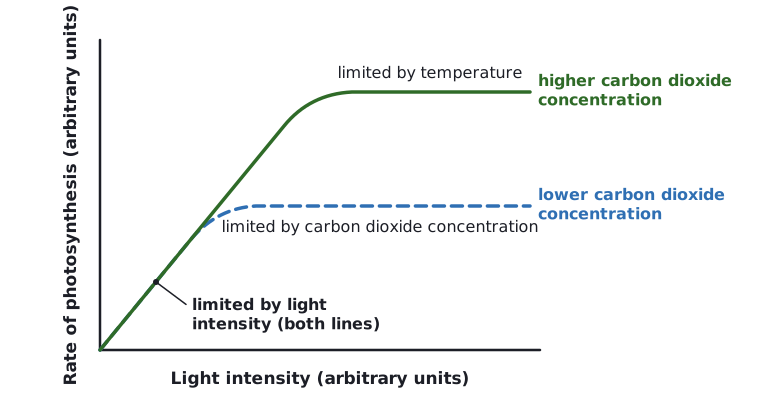
To explain a graph, find where the line levels off. At that point the factor on the x-axis is no longer limiting. Something else is, and it will be a factor that is not being increased.
- If a graph for light intensity has two lines, the line with a higher plateau has more of the other factor, for example a higher carbon dioxide concentration or a better temperature.
- The two lines are the same at low light intensity because light is the limiting factor for both.
- At the plateau, the lower line is limited by the factor that differs between the two conditions.
- If increasing one factor makes no difference to the rate, a different factor is limiting.
 Tap to enlarge
Core practical: light intensity and photosynthesisSpec 6.5
You can investigate how light intensity affects the rate of photosynthesis using an aquatic plant such as pondweed. The light intensity is changed by moving a lamp to different distances from the plant.
- Cut a piece of pondweed and place it in a boiling tube or beaker of water with a little sodium hydrogencarbonate, which supplies carbon dioxide. Place a heat shield (a clear container of water) between the lamp and the plant, or use an LED lamp, to keep the temperature constant.
- Place a lamp a measured distance from the pondweed, for example 10 cm, using a ruler. Switch off or block other light sources.
- Leave the pondweed for a couple of minutes to adjust to the new light level.
- Count the number of bubbles of oxygen released from the cut end of the stem in one minute. (You can instead collect the gas and measure its volume.)
- Repeat at different distances, for example 20, 30, 40 and 50 cm.
- Repeat each distance at least three times and calculate a mean rate.
| Type | Variable | How it is controlled or measured |
|---|---|---|
| Independent | Light intensity | Changed by changing the distance between the lamp and the plant |
| Dependent | Rate of photosynthesis | Measured as the number of bubbles per minute, or the volume of gas collected per minute |
| Control | Temperature | Heat shield or water bath, and a lamp that gives out little heat |
| Control | Carbon dioxide concentration | Same amount of sodium hydrogencarbonate in the water each time |
| Control | The plant | Same piece of pondweed, with the same length of stem, for every distance |
Typical results: the further the lamp is from the plant, the lower the light intensity, so fewer bubbles are released per minute. Plot the mean rate (y-axis) against the distance or light intensity (x-axis).
Because light intensity is inversely proportional to the square of the distance, plotting the rate against 1 ÷ distance² should give a straight line while light is the limiting factor.
Counting bubbles is not very accurate because bubbles can be different sizes. Collecting the gas and measuring its volume gives better data.
Light intensity, distance and the inverse square lawSpec 6.6Higher tier
When light is the limiting factor, the rate of photosynthesis is directly proportional to light intensity. If the light intensity doubles, the rate doubles.
The light intensity falls as the distance from the light source increases. So the rate of photosynthesis is inversely proportional to the distance from the light source. The exact relationship is the inverse square law: light intensity is proportional to 1 ÷ distance², so the rate is too.
- Double the distance: the intensity becomes 1 ÷ 2² = one quarter.
- Treble the distance: the intensity becomes 1 ÷ 3² = one ninth.
- Halve the distance: the intensity becomes 1 ÷ (½)² = four times as much.
Using the inverse square law
A pondweed 10 cm from a lamp releases 36 bubbles per minute. Light is the limiting factor. Predict the number of bubbles per minute when the lamp is moved to 30 cm.
- The distance has increased by a factor of 30 ÷ 10 = 3.
- Light intensity is proportional to 1 ÷ distance², so the intensity falls by a factor of 3² = 9.
- The rate is directly proportional to light intensity, so the rate also falls by a factor of 9.
- New rate = 36 ÷ 9 = 4 bubbles per minute.
Answer: 4 bubbles per minute
Quick check
Why are photosynthetic organisms called the main producers of biomass?
Show answer
They make their own food (glucose) by photosynthesis, which builds biomass that other organisms feed on.
Why is photosynthesis described as endothermic?
Show answer
It takes in energy from the surroundings, in the form of light.
Name the three limiting factors of photosynthesis.
Show answer
Temperature, light intensity and carbon dioxide concentration.
In the light intensity core practical, how is the light intensity changed?
Show answer
By changing the distance between the lamp and the pondweed.