

The heart and circulatory systemSpec 8.8
Humans have a double circulatory system. In one circuit the blood goes from the heart to the lungs and back. In the other the blood goes from the heart around the body and back. Blood passes through the heart twice on each complete circuit of the body.
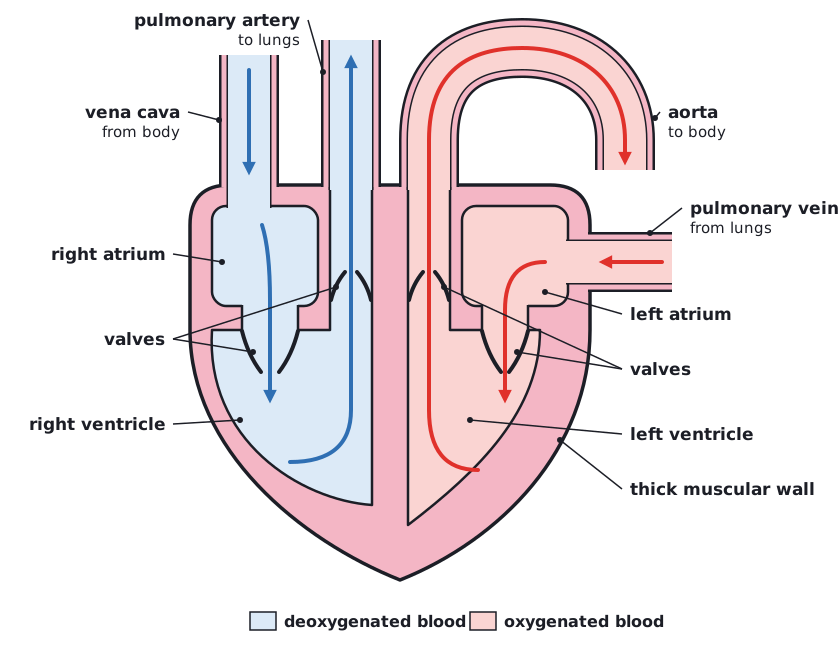
- Deoxygenated blood from the body enters the right atrium through the vena cava.
- The right atrium contracts and pushes blood into the right ventricle.
- The right ventricle contracts and pumps blood to the lungs through the pulmonary artery.
- Oxygenated blood returns from the lungs through the pulmonary vein into the left atrium.
- The left atrium contracts and pushes blood into the left ventricle.
- The left ventricle contracts and pumps blood around the body through the aorta.
| Blood vessel | Carries blood | Between |
|---|---|---|
| Vena cava | Deoxygenated | Body → right atrium |
| Pulmonary artery | Deoxygenated | Right ventricle → lungs |
| Pulmonary vein | Oxygenated | Lungs → left atrium |
| Aorta | Oxygenated | Left ventricle → body |
Valves
The heart has valves between the atria and ventricles, and where the pulmonary artery and aorta leave the ventricles. They open to let blood through in one direction and close to prevent backflow.
Thickness of the chamber walls
- The ventricles have thicker, more muscular walls than the atria, because they pump blood out of the heart and further.
- The left ventricle has a thicker wall than the right ventricle. It pumps blood around the whole body, which needs a higher pressure. The right ventricle pumps blood only to the lungs, which are close by.
The blood pressure falls as blood passes through the capillaries in the lungs. Returning the blood to the heart before it goes to the body lets the left ventricle increase the pressure again, so blood can reach the rest of the body quickly.
 Tap to enlarge
Heart rate, stroke volume and cardiac outputSpec 8.12
- Heart rate
- The number of times the heart beats per minute (bpm).
- Stroke volume
- The volume of blood pumped out of the heart in each beat, in cm³.
- Cardiac output
- The volume of blood pumped out of the heart per minute, in cm³ per minute.
Calculating cardiac output
A person has a resting heart rate of 70 beats per minute and a stroke volume of 75 cm³. Calculate the cardiac output.
- cardiac output = stroke volume × heart rate
- cardiac output = 75 × 70 = 5250
Answer: 5250 cm³ per minute
You may be asked to rearrange the equation. Stroke volume = cardiac output ÷ heart rate. Heart rate = cardiac output ÷ stroke volume.
You can measure heart rate by taking a pulse for a set time, for example counting beats in 30 seconds and doubling. A suggested practical is to investigate the short-term effect of exercise on heart rate and breathing rate, which both increase to supply more oxygen to the working muscles.
Quick check
Which vessel carries oxygenated blood from the lungs to the heart?
Show answer
The pulmonary vein.
Why is the wall of the left ventricle thicker than the wall of the right ventricle?
Show answer
It pumps blood around the whole body, which needs a higher pressure than pumping blood to the lungs.
What is the job of the valves in the heart?
Show answer
To prevent backflow and keep blood flowing in one direction.
State the equation for cardiac output.
Show answer
Cardiac output = stroke volume × heart rate.