
Sex determinationSpec 3.15
In short
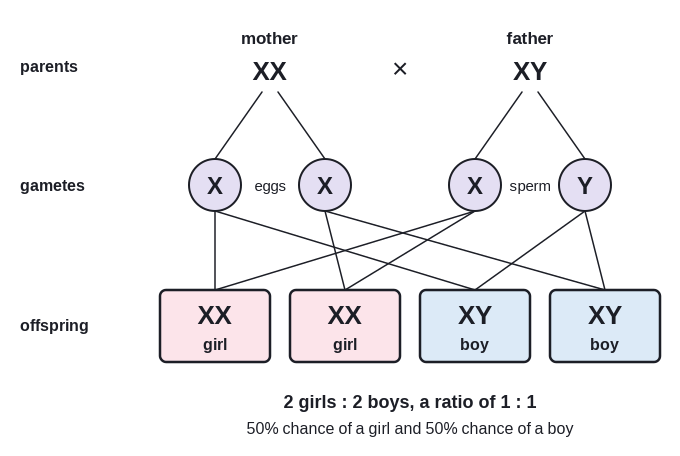
Sex is determined by one pair of sex chromosomes: females are XX and males are XY. All eggs carry an X chromosome, while half of sperm carry an X and half carry a Y. The sperm that fertilises the egg decides the sex, so there is a 50% probability of a boy or a girl.
Humans have 23 pairs of chromosomes. One pair is the sex chromosomes. Females have two X chromosomes (XX). Males have one X and one Y chromosome (XY).
All eggs carry an X chromosome. Half of the sperm carry an X and half carry a Y. The sex of the offspring is decided at fertilisation by which sperm fertilises the egg.
| X (egg) | X (egg) | |
|---|---|---|
| X (sperm) | XX female | XX female |
| Y (sperm) | XY male | XY male |
 (opens full size in a new tab)
Two outcomes are female and two are male, so the ratio is 1 : 1 and there is a 50% probability that a baby will be a boy or a girl.
The father's sperm decides the sex of the baby, because it carries either an X or a Y. Every egg carries an X.
Probabilities, ratios and percentages
The same answer can be written in three ways. The probability of a boy is 0.5 (or 1 in 2), the expected ratio of girls to boys is 1 : 1, and the percentage chance of a boy is 50%. Each fertilisation is a separate event, so earlier children do not change the chance for the next one.
The chance of a boy in the next pregnancy
A couple already have three daughters. Calculate the probability that their next child will be a boy. Give your answer as a percentage. [2]
- The mother's eggs all carry X; half of the father's sperm carry X and half carry Y, so the offspring are XX : XY in a 1 : 1 ratio (1 mark).
- Each fertilisation is independent of the earlier ones, so the probability of XY is 1 in 2 (1 mark).
Answer: 50%
Common wrong answers
- After three girls, a boy is more likely. Wrong: the chance is still 50% for every child.
- A 1 : 1 ratio means a family of four will have two boys and two girls. The ratio is a probability. It tells you what to expect over many births, not in one family.
- Writing a gamete as XY. Each gamete has only one sex chromosome: eggs are X; sperm are X or Y.
Written and checked against the Edexcel GCSE Biology (1BI0) specification · Updated October 2026