

The structure and function of bloodSpec 8.6
Blood is a tissue made of plasma with red blood cells, white blood cells and platelets suspended in it.
| Component | Structure | Function |
|---|---|---|
| Red blood cells (erythrocytes) | Biconcave disc shape, no nucleus, full of haemoglobin | Carry oxygen from the lungs to the cells. Haemoglobin combines with oxygen to form oxyhaemoglobin |
| White blood cells: phagocytes | Flexible, so they can change shape to surround a pathogen | Engulf (take in) pathogens and digest them. This is phagocytosis |
| White blood cells: lymphocytes | Make and release antibodies into the blood | Antibodies attach to specific pathogens and help to destroy them |
| Plasma | Pale yellow liquid | Transports blood cells and dissolved substances: carbon dioxide, urea, digested food molecules, mineral ions and hormones |
| Platelets | Small fragments of cells, with no nucleus | Help the blood to clot at a wound |
Red blood cells
- The biconcave disc shape gives a large surface area for oxygen to be absorbed.
- Haemoglobin binds to oxygen, so the cell can carry a lot of oxygen.
- There is no nucleus, which leaves more room for haemoglobin.
White blood cells
Phagocytes can change shape, so they can surround and engulf pathogens and then digest them. Lymphocytes make antibodies that attach to specific pathogens and help to destroy them.
Plasma and platelets
Plasma is the liquid part of blood and carries many dissolved substances around the body. Platelets make the blood clot where there is a cut. This stops blood loss and stops pathogens entering the body.
Standard form with blood cell counts
A sample of blood has 5 × 10⁶ red blood cells in each mm³. How many red blood cells are there in 2 mm³? Give your answer in standard form.
- Multiply: 2 × 5 × 10⁶ = 10 × 10⁶ = 10 000 000.
- Write as a number between 1 and 10 multiplied by a power of ten: 1 × 10⁷.
Answer: 1 × 10⁷ red blood cells
The structure and function of blood vesselsSpec 8.7
There are three types of blood vessel. Each is adapted to its job.
| Artery | Vein | Capillary | |
|---|---|---|---|
| Direction of blood | Away from the heart | Towards the heart | Between arteries and veins, through the tissues |
| Blood pressure | High | Low | Falls as blood passes through |
| Wall | Thick, muscular, with elastic fibres | Thinner wall | One cell thick |
| Lumen | Narrow | Wide | Very narrow |
| Valves | No | Yes | No |
| Function | Carry blood at high pressure to the organs | Carry blood back to the heart | Exchange substances with cells |
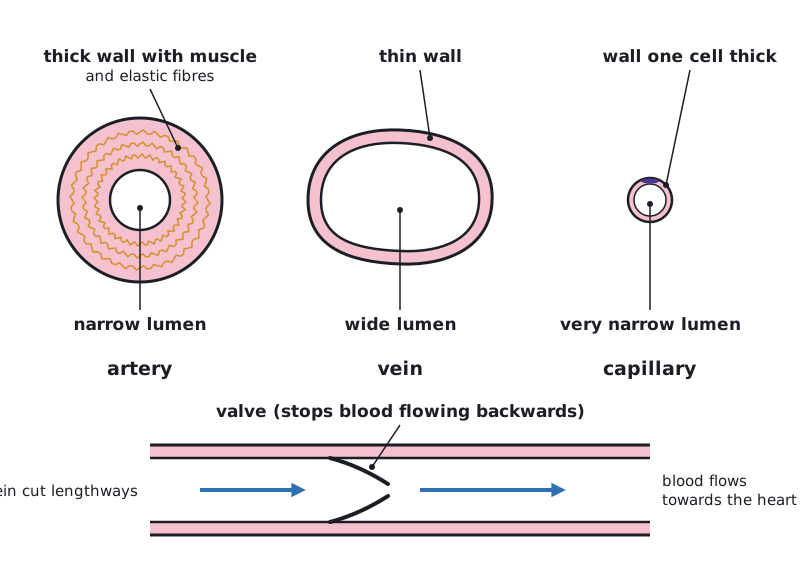
- Arteries have thick, muscular walls and elastic fibres. The wall can stand the high pressure and stretches and springs back with each heartbeat.
- Veins carry blood at low pressure. They have a wide lumen to let blood flow easily, and valves to stop the blood flowing backwards.
- Capillaries have walls only one cell thick, giving a short diffusion distance. They form a huge network so there is a large surface area for exchange, and they are narrow so they can reach every cell.
 Tap to enlarge
Quick check
Which part of the blood carries oxygen, and what is the name of the substance that binds to it?
Show answer
Red blood cells; haemoglobin.
What is the job of phagocytes?
Show answer
They engulf and digest pathogens.
Which blood vessels have valves?
Show answer
Veins.
Why are capillary walls only one cell thick?
Show answer
To give a short diffusion distance for exchange of substances.