

Specialised cellsSpec 1.2
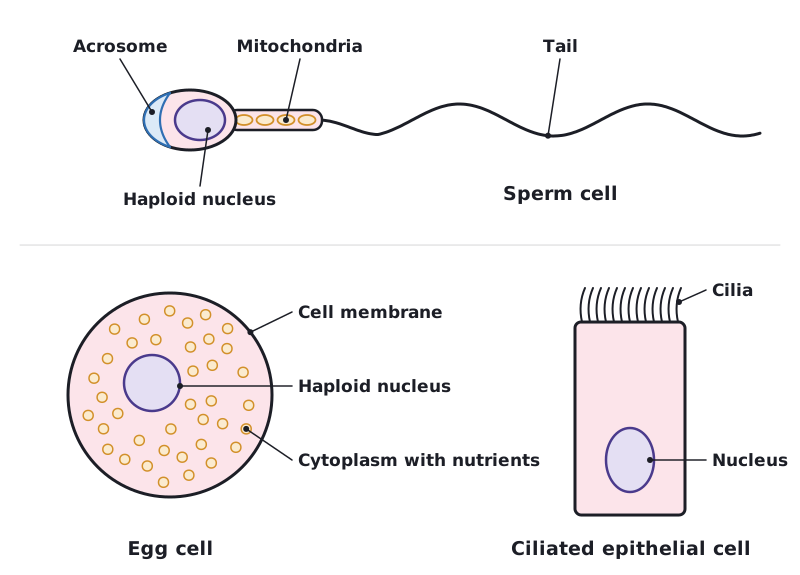
A specialised cell has features, called adaptations, that help it do its job. You need to describe how sperm cells, egg cells and ciliated epithelial cells are adapted.
Sperm cells
The job of a sperm cell is to reach an egg cell and fuse with it at fertilisation.
| Adaptation | How it helps |
|---|---|
| Acrosome | Contains digestive enzymes that break down the outer layers of the egg cell so the sperm can get in |
| Haploid nucleus | Contains half the number of chromosomes of a normal body cell, so fertilisation restores the full number |
| Many mitochondria | Release energy by aerobic respiration for the tail to move |
| Tail | Moves from side to side to push the sperm along, so it can swim to the egg |
Egg cells
| Adaptation | How it helps |
|---|---|
| Nutrients in the cytoplasm | A food store that supplies the early embryo with nutrients and energy to grow |
| Haploid nucleus | Contains half the number of chromosomes, which join with the sperm nucleus at fertilisation |
| Changes in the cell membrane after fertilisation | The membrane changes straight after a sperm enters, so no more sperm can get in |
Ciliated epithelial cells
These cells line parts of the airways. Their surface has cilia, tiny hair-like projections. The cilia beat together and move mucus, which has trapped dust and microorganisms, away from the lungs.
 Tap to enlarge
Quick check
Name the three structures found in plant cells but not in animal cells.
Show answer
Cell wall, chloroplasts and vacuole.
Where is the DNA in a bacterial cell?
Show answer
Free in the cytoplasm, as chromosomal DNA and plasmid DNA. There is no nucleus.
What is the function of the acrosome?
Show answer
It contains enzymes that digest the outer layers of the egg.
Why does a sperm cell have a haploid nucleus?
Show answer
It has half the chromosomes, so fusing with the egg nucleus gives the full number.
What do the cilia on ciliated epithelial cells do?
Show answer
They move mucus containing trapped dust and microorganisms away from the lungs.