

The cell cycle and mitosisSpec 2.1
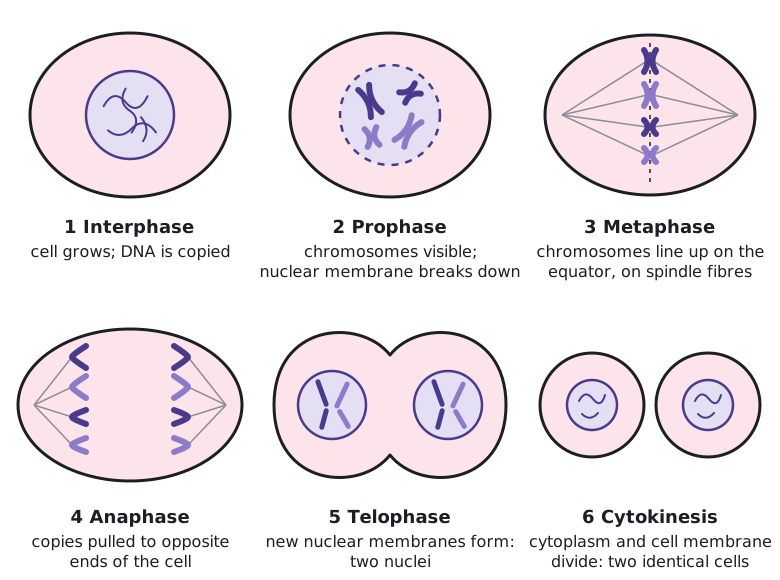
Cells grow and divide in a repeating sequence called the cell cycle. Most of the cycle is interphase, when the cell is not dividing. Mitosis is the part of the cycle in which the nucleus divides. It is followed by cytokinesis, when the cytoplasm and cell membrane divide.
| Stage | What happens |
|---|---|
| Interphase | The cell grows and makes more of its sub-cellular structures. The DNA is copied, so each chromosome is made of two identical copies (chromatids). |
| Prophase | The chromosomes become shorter and thicker, so they can be seen. The membrane around the nucleus breaks down. |
| Metaphase | The chromosomes line up along the middle (the equator) of the cell. They are attached to spindle fibres. |
| Anaphase | The spindle fibres pull the two copies of each chromosome apart, to opposite ends of the cell. |
| Telophase | A new nuclear membrane forms around each set of chromosomes, so there are two nuclei. |
| Cytokinesis | The cytoplasm and cell membrane divide to make two separate cells. |
The order is interphase, prophase, metaphase, anaphase, telophase, then cytokinesis.
 Tap to enlarge