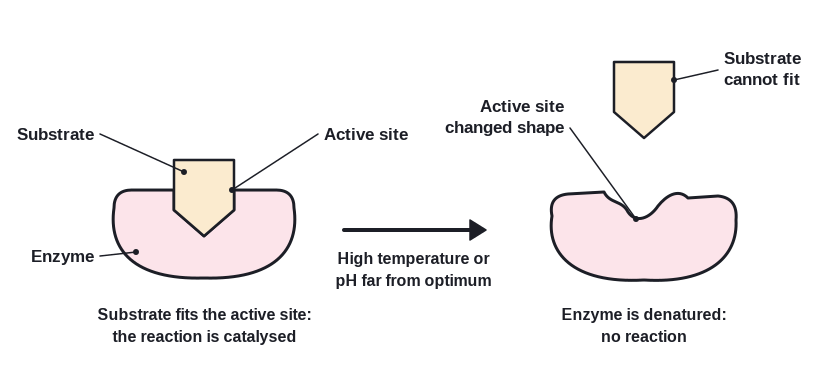
An enzyme is denatured when a high temperature, or a pH too far from its optimum, breaks the bonds that hold it in shape. The active site changes shape, so the substrate no longer fits and the reaction cannot be catalysed. Denaturing is permanent. Enzymes are not 'killed' by heat, because they were never alive.
If the temperature is too high, or the pH is too far from the enzyme's optimum, the bonds that hold the enzyme in shape are broken. The enzyme changes shape, and so does the active site.
The substrate no longer fits the active site, so the enzyme cannot catalyse the reaction. The enzyme is denatured. This change is permanent.
Enzymes are not 'killed' by heat, because they were never alive. Write that the enzyme is denatured and the shape of the active site has changed.
Written and checked against the Edexcel GCSE Biology (1BI0) specification · Updated October 2026
Frequently asked questions
How do enzymes speed up reactions?
Enzymes speed up reactions by acting as biological catalysts, without being used up. The substrate collides with the enzyme's active site and fits into it because their shapes are complementary, forming an enzyme-substrate complex. The reaction happens at the active site, the products leave, and the enzyme can be used again.
Why do enzymes denature at high temperatures?
Enzymes denature at high temperatures because the bonds that hold the enzyme in shape are broken. The enzyme and its active site change shape, so the substrate no longer fits and the reaction cannot be catalysed. This change is permanent, so above the optimum temperature the rate falls quickly towards zero.
What happens to enzymes at low temperatures?
At low temperatures enzymes work slowly, but they are not denatured. The particles have less kinetic energy and move more slowly, so the enzyme and substrate collide less often and the rate of reaction is lower. As the temperature rises towards the optimum, collisions become more frequent and the rate increases.

 (opens full size in a new tab)