

Cellular respirationSpec 8.9
Cellular respiration is an exothermic reaction. It transfers energy to the surroundings, and some of this energy is released as heat. It happens continuously in living cells (in plants as well as animals) to release energy for metabolic processes.
Metabolic processes include building larger molecules from smaller ones, muscle contraction, and keeping the body warm in mammals and birds.
Aerobic respiration
Aerobic respiration uses oxygen to break down glucose.
Anaerobic respiration
Anaerobic respiration happens without oxygen. In animal cells, such as muscle cells working hard, glucose is broken down to lactic acid. In plant cells and yeast, glucose is broken down to ethanol and carbon dioxide.
Comparing aerobic and anaerobic respirationSpec 8.10
| Aerobic respiration | Anaerobic respiration | |
|---|---|---|
| Oxygen needed? | Yes | No |
| Glucose breakdown | Complete breakdown | Incomplete breakdown |
| Energy released | A large amount per glucose molecule | Much less per glucose molecule |
| Products in animals | Carbon dioxide and water | Lactic acid |
| Products in plants and yeast | Carbon dioxide and water | Ethanol and carbon dioxide |
| When it happens | Whenever enough oxygen is available | When oxygen is not available, for example in muscles during vigorous exercise |
Aerobic respiration releases much more energy because glucose is completely broken down. Anaerobic respiration releases less energy because glucose is only partly broken down. Both types of respiration are exothermic and both release energy from glucose.
Core practical: the rate of respiration in living organismsSpec 8.11
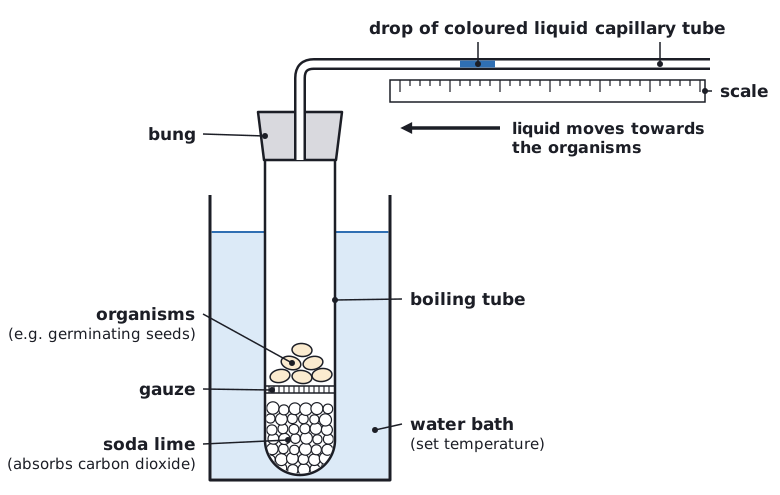
Respiration can be investigated by measuring how fast a living organism, such as germinating seeds or small invertebrates, uses up oxygen. This is done with a respirometer.
- Place the organisms in a boiling tube. Put a layer of soda lime (or another carbon dioxide absorber) in the tube, separated from the organisms by cotton wool or gauze.
- Connect the tube to a capillary tube containing a drop of coloured liquid, and seal the apparatus so that no air can get in or out.
- Place the tube in a water bath at a set temperature and leave it to settle.
- Measure the distance the coloured liquid moves in a set time, for example 5 minutes.
- Repeat at different temperatures, and repeat each temperature to calculate a mean.
- Set up a control tube with an equal volume of an inert material, such as glass beads, instead of organisms.
The organisms use up oxygen. The carbon dioxide they produce is absorbed, so the volume of gas in the tube falls and the coloured liquid moves towards the organisms. The further it moves in a given time, the faster the rate of respiration.
| Type of variable | Example |
|---|---|
| Independent variable | Temperature (or the type of organism, if comparing organisms) |
| Dependent variable | Distance moved by the liquid in a set time |
| Control variables | Mass of organisms, volume of soda lime, time, volume of the apparatus, start position of the liquid |
A suggested practical for anaerobic respiration is to investigate the effect of glucose concentration on the rate of anaerobic respiration in yeast. The rate can be found by measuring how quickly carbon dioxide is produced, for example by counting bubbles or measuring the volume of gas collected.
 Tap to enlarge
Quick check
What does exothermic mean?
Show answer
Energy is transferred to the surroundings.
Write the word equation for aerobic respiration.
Show answer
Glucose + oxygen → carbon dioxide + water.
What are the products of anaerobic respiration in yeast?
Show answer
Ethanol and carbon dioxide.
Why does the coloured liquid move towards the organisms in a respirometer?
Show answer
The organisms use up oxygen and the carbon dioxide is absorbed, so the volume of gas decreases.