

What is health?Spec 5.1
Health is not just about being free from illness. The World Health Organization (WHO) defines health as a state of complete physical, mental and social well-being and not merely the absence of disease or infirmity.
| Part of health | What it means | Example of it going wrong |
|---|---|---|
| Physical | The body is working properly and is free from disease | Having an infection such as tuberculosis |
| Mental | Being able to think clearly and cope with everyday life | Long-term anxiety or depression |
| Social | Having good relationships and a place in the community | Being isolated or lonely |
Someone can have no disease and still not be healthy by this definition. For example, a person who is physically fit but severely stressed and isolated is not in a state of complete well-being.
Communicable and non-communicable diseasesSpec 5.2
A communicable disease can be passed from one organism to another. It is caused by a pathogen, so it is also called an infectious disease. Cholera, tuberculosis and malaria are communicable.
A non-communicable disease cannot be passed from one person to another. It is not caused by a pathogen. Cardiovascular disease, many cancers and diseases linked to nutrition are non-communicable.
| Communicable | Non-communicable | |
|---|---|---|
| Cause | A pathogen | Not a pathogen; often a mix of several factors |
| Passed on? | Yes, between people (or animals or plants) | No |
| Examples | Cholera, tuberculosis, malaria, HIV | Heart disease, lung cancer, liver disease |
How one disease can lead to anotherSpec 5.3
Having one disease can make you more susceptible (more likely to catch) other diseases. There are several ways this happens.
- A weakened immune system. HIV destroys white blood cells, so the body cannot fight off other pathogens. People with HIV are much more likely to develop infections such as tuberculosis.
- Damaged barriers. A disease that damages the skin or the lining of the airways makes it easier for other pathogens to get in.
- Poor nutrition. Some diseases make it hard to eat or absorb food. A poorly nourished body makes fewer of the cells and chemicals needed for defence.
- Mental health. A long-term physical illness can lead to depression or anxiety. Poor mental health can in turn make physical health worse.
Using data
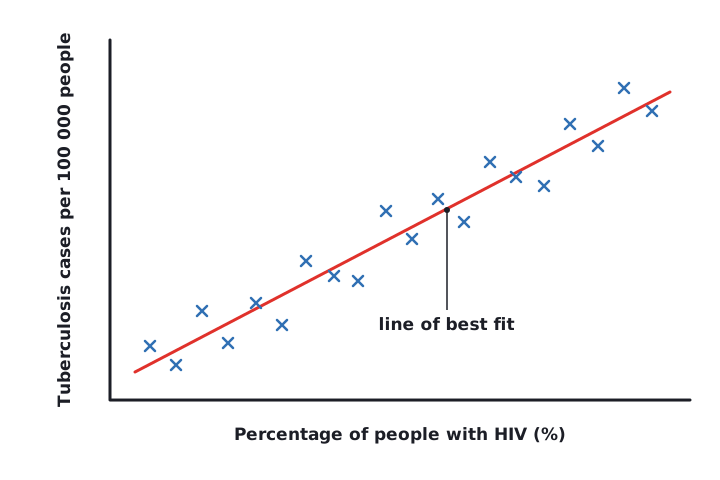
You may be given a table, graph or scatter diagram linking two diseases. A scatter diagram can show a correlation: as one variable changes, the other changes too. A correlation does not prove that one disease causes the other. Something else could be responsible for both.
Data from a larger, randomly chosen sample is more reliable than data from a small one. Also check that the people sampled are representative of the group the conclusion is about.
Reading a scatter diagram
A scatter diagram shows that in 20 regions, the regions with more people infected with HIV also have more people with tuberculosis. Describe the pattern and state what can be concluded.
- The points slope upwards from left to right.
- As HIV infections increase, tuberculosis cases increase, so there is a positive correlation.
- A correlation does not show cause, but it is consistent with HIV making people more susceptible to tuberculosis.
Answer: Positive correlation between HIV and tuberculosis. It supports, but does not prove, that HIV increases susceptibility to tuberculosis.
 Tap to enlarge
Quick check
Give the WHO definition of health.
Show answer
A state of complete physical, mental and social well-being and not merely the absence of disease or infirmity.
What is the main difference between communicable and non-communicable diseases?
Show answer
Communicable diseases are caused by pathogens and can be passed on; non-communicable diseases cannot be passed on.
Explain why someone with HIV is more likely to get tuberculosis.
Show answer
HIV destroys white blood cells, so the immune system is weakened and cannot fight off other pathogens.
What does a positive correlation on a scatter diagram show?
Show answer
As one variable increases, the other also increases.