
Book a tutor
Book a tutor

Aseptic techniques

Note 2 of 7 · Antibiotics, culturing microorganisms and new medicines · Health, disease and the development of medicines

Spec 5.17B
Triple only (what this means)Triple only: only in Triple Biology. Combined Science students can skip it. What the labels mean
Download all Antibiotics, culturing microorganisms and new medicines notes (PDF)Download PDF7 pages

Aseptic techniquesSpec 5.17B

In short

Aseptic technique stops unwanted microorganisms getting into a culture and stops the culture escaping. The agar and petri dishes are sterilised in an autoclave, and the inoculating loop is heated in a flame until red hot, then cooled. Lids are lifted only briefly, then taped on, and the dishes are incubated upside down.

To grow (culture) microorganisms safely and get reliable results, you must stop unwanted microorganisms getting in and stop your culture escaping. This is called aseptic technique.

  • Use an autoclave to prepare the sterile growth medium (agar jelly) and the petri dishes. An autoclave sterilises equipment using high-pressure steam, which kills microorganisms already present.
  • Use a sterile inoculating loop to transfer microorganisms. The loop is sterilised by heating in a flame until red hot, then cooled before use.
  • Keep petri dishes and culture vials covered as much as possible. Only lift the lid briefly when transferring microorganisms.
  • After inoculating, fix the lid on with tape and incubate the dish upside down.
  • Wash your hands and wipe the bench with disinfectant before and after.
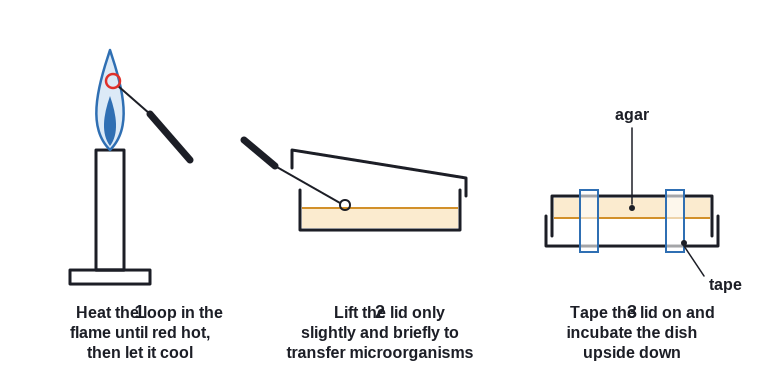
Three steps of aseptic technique: an inoculating loop heated in a Bunsen flame until red hot, a petri dish lid lifted only slightly while the loop transfers microorganisms onto the agar, and a dish with its lid taped on, incubated upside down. (opens full size in a new tab)
Flame the loop, lift the lid only slightly, then tape the lid on and incubate the dish upside down.
Exam tip:

Always give the reason. 'Flame the loop to kill any microorganisms on it, so the culture is not contaminated' scores; just 'flame the loop' does not.

Written and checked against the Edexcel GCSE Biology (1BI0) specification · Updated October 2026

Frequently asked questions

Why can't antibiotics kill viruses?

Antibiotics cannot kill viruses because they work by inhibiting cell processes in bacteria, and viruses are not cells. Viruses live and reproduce inside host cells, so they do not have the cell processes that antibiotics target. This is why antibiotics cannot be used to treat viral diseases such as HIV, colds or flu.

What are the stages of developing a new medicine?

New medicines go through four stages: discovery of a chemical that might treat the disease, development to improve it, preclinical testing on cells, tissues and live animals to check toxicity and effectiveness, and clinical testing on people. Clinical testing starts with a few healthy volunteers to check safety, then patients to find the dose.

Why are bacterial cultures incubated at 25 °C?

Triple only Bacterial cultures are incubated at 25 °C because a lower temperature makes it less likely that harmful pathogens, which grow best at body temperature, will grow. The lid is taped on but not fully sealed, so microorganisms cannot escape or get in, but oxygen can still enter. The dish is incubated upside down.

All 5 questions on Antibiotics, culturing microorganisms and new medicines

Need help with this topic? Book a tutor for one-to-one lessons, online or in Dubai.