

Leaf structureSpec 6.11BTriple only
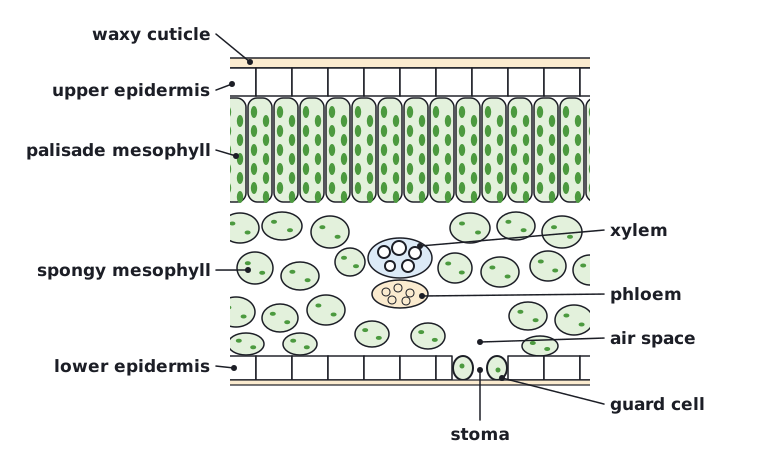
A leaf is adapted to absorb light for photosynthesis and to allow gas exchange of carbon dioxide and oxygen.
| Structure | Adaptation | How it helps |
|---|---|---|
| Whole leaf | Broad, flat and thin | Large surface area to absorb light, and a short distance for gases to diffuse |
| Waxy cuticle | A waxy, waterproof layer on the surface | Reduces water loss by evaporation |
| Upper epidermis | A thin layer of transparent cells | Lets light through to the cells underneath |
| Palisade mesophyll | Tightly packed, tall cells near the top of the leaf, with many chloroplasts | Most photosynthesis takes place here, close to the light |
| Spongy mesophyll | Loosely arranged cells with air spaces between them | Carbon dioxide can diffuse through the leaf to the cells, and oxygen can diffuse out |
| Stomata and guard cells | Pores, mostly in the lower epidermis, opened and closed by guard cells | Allow gases to enter and leave, and control water loss |
| Xylem and phloem (veins) | Vascular bundles running through the leaf | Xylem brings water for photosynthesis. Phloem carries sucrose away. |
 Tap to enlarge
Factors affecting water uptakeSpec 6.12
The rate at which a plant takes up water depends on the rate of transpiration. When more water is lost from the leaves, more is pulled up through the xylem. Three environmental factors affect it.
| Factor | Effect on water uptake | Explanation |
|---|---|---|
| Light intensity | Higher light intensity increases the rate | Stomata open in the light, so more water vapour can diffuse out of the leaf. Low light or darkness makes the stomata close. |
| Air movement | More air movement increases the rate | Moving air carries away water vapour from around the stomata. This keeps a steep concentration gradient, so water vapour diffuses out faster. |
| Temperature | Higher temperature increases the rate | Water evaporates from the cells faster, and water vapour particles move faster, so diffusion out of the leaf is faster. |
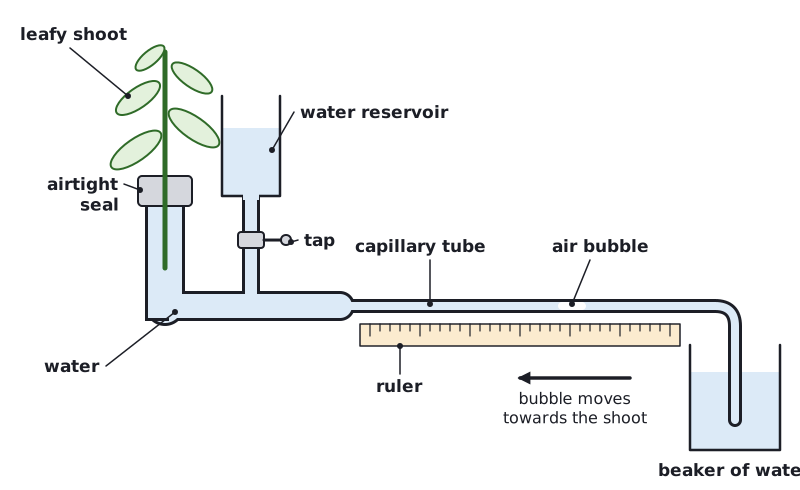
A potometer is used to measure the rate of water uptake of a leafy shoot. As the shoot takes up water, an air bubble moves along a capillary tube. The distance moved in a set time is a measure of the rate. You can compare the rate in different conditions, for example with and without a fan, or in the light and in the shade.
 Tap to enlarge
Rate calculations for transpirationSpec 6.13
A rate tells you how much something changes in a unit of time. For water uptake or transpiration you can use the distance moved by a bubble in a potometer, the volume of water lost, or the change in mass of a plant.
Rate of water uptake
In a potometer, an air bubble moved 31 mm, 28 mm and 34 mm in three repeats of 10 minutes each. Calculate the mean rate of water uptake in mm per minute.
- Mean distance = (31 + 28 + 34) ÷ 3 = 93 ÷ 3 = 31 mm.
- Rate = distance ÷ time = 31 ÷ 10 = 3.1 mm per minute.
Answer: 3.1 mm per minute
Percentage loss of mass
A leafy shoot had a mass of 25.0 g at the start of an investigation and 23.0 g at the end. Calculate the percentage loss of mass.
- Loss of mass = 25.0 − 23.0 = 2.0 g.
- Percentage loss = 2.0 ÷ 25.0 × 100 = 8%.
Answer: 8%
Plants in extreme environmentsSpec 6.14BTriple only
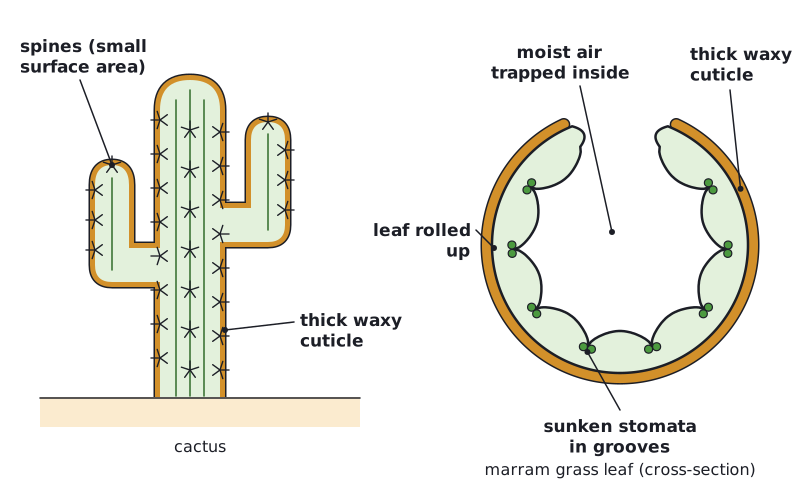
Plants that live in hot, dry or windy places lose water very easily. They have adaptations that reduce water loss by transpiration. These adaptations affect leaf size and shape, the cuticle and the stomata.
| Feature | Adaptation | How it helps |
|---|---|---|
| Leaf size and shape | Small, narrow or needle-like leaves, spines (as in a cactus), or leaves that roll up (as in marram grass) | A smaller surface area means less water evaporates. Rolled leaves trap moist air around the stomata. |
| Cuticle | A thick, waxy cuticle | Waterproof, so less water evaporates through the leaf surface |
| Stomata | Fewer stomata, or stomata sunk in pits, or stomata that are closed during the day | Less water vapour diffuses out. In sunken stomata, moist air is trapped in the pit, which reduces the concentration gradient. |
These adaptations come at a cost. With less leaf area and fewer or closed stomata, less carbon dioxide can enter the plant, so these plants often photosynthesise and grow slowly.
 Tap to enlarge
Quick check
What does a potometer measure?
Show answer
The rate of water uptake of a leafy shoot.
Why does moving air increase the rate of transpiration?
Show answer
It carries away water vapour, keeping a steep concentration gradient so water vapour diffuses out faster.
A bubble in a potometer moves 24 mm in 8 minutes. What is the rate?
Show answer
24 ÷ 8 = 3 mm per minute.
Why does a higher temperature increase the rate of water uptake?
Show answer
Water evaporates from the leaf cells faster and water vapour diffuses out faster, so more water is pulled up the xylem.