
Mutations that change protein structureSpec D1.2.11
In short
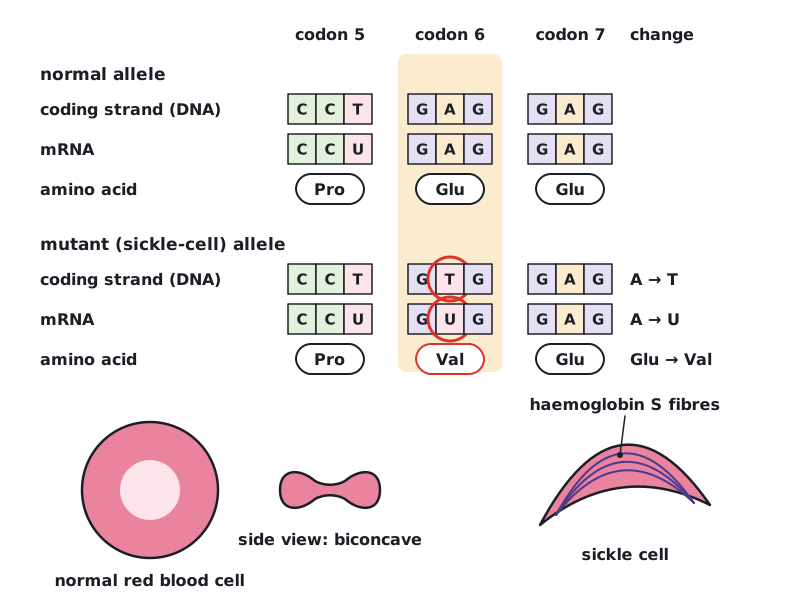
A mutation that changes the base sequence of a gene can change the amino acid sequence of its polypeptide, and so the protein's structure. In sickle-cell anaemia, a base substitution in the haemoglobin beta-chain gene changes the codon GAG to GUG, so valine replaces glutamic acid. Haemoglobin S forms fibres at low oxygen, distorting red blood cells.
The amino acid sequence of a polypeptide decides how it folds and therefore its three-dimensional structure. A change in the base sequence of a gene can change the codons in the mRNA, and so the amino acid sequence, the folding and the function of the protein.
Example: sickle-cell anaemia
- The gene for the beta chain of haemoglobin has a base substitution: on the coding strand, A is replaced by T (GAG becomes GTG).
- The mRNA codon becomes GUG instead of GAG.
- At the sixth amino acid of the beta chain, valine replaces glutamic acid. The resulting form is haemoglobin S.
- Glutamic acid is charged and hydrophilic; valine is non-polar and hydrophobic. At low oxygen concentrations, haemoglobin S molecules stick together into long fibres.
- The fibres distort red blood cells into a rigid sickle shape. Sickle cells can block capillaries and carry less oxygen, and they are broken down faster, causing anaemia.
A change to just one base of the gene is enough to alter the protein. This shows how closely protein structure depends on base sequence.
 (opens full size in a new tab)
In a sickle-cell answer, give the base change, the codon change (GAG → GUG), the amino acid change (Glu → Val) and the effect on haemoglobin and red blood cells. Each is a separate marking point.
Quick check
Which base on RNA pairs with adenine on the DNA template strand?
Show answer
Uracil.
Why must DNA in non-dividing somatic cells stay unchanged by transcription?
Show answer
The same sequences must be transcribed throughout the life of the cell, so they must be conserved.
What is meant by the degeneracy of the genetic code?
Show answer
More than one codon can code for the same amino acid.
How many tRNAs can bind to the large ribosomal subunit at once?
Show answer
Two.
Written and checked against the IB Biology SL specification · Updated October 2026