
Carbon atoms and the diversity of carbon compoundsSpec B1.1.1
In short
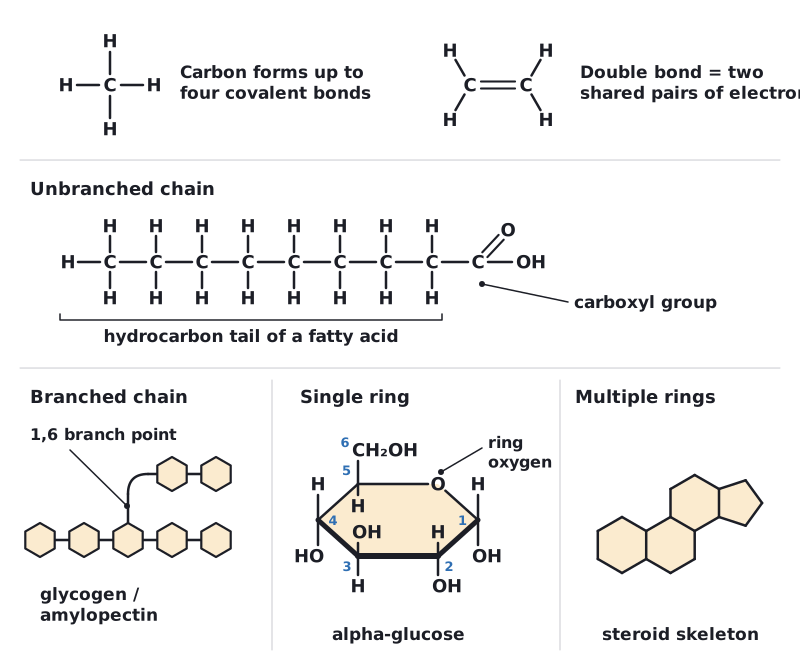
A covalent bond is a bond in which two atoms share a pair of electrons. A carbon atom can form up to four covalent bonds, single or double, with other carbon atoms or with non-metals such as hydrogen, oxygen, nitrogen and phosphorus. This lets carbon build stable chains, branches and rings, the basis of the diverse compounds of life.
Life is based on carbon compounds. Carbohydrates, lipids, proteins and nucleic acids all have a skeleton of carbon atoms. The reason lies in how carbon bonds.
- Covalent bond
- A bond formed when two atoms share a pair of electrons. Covalent bonds are strong, so molecules built from them are stable.
- Single bond
- One shared pair of electrons, e.g. C–C or C–H.
- Double bond
- Two shared pairs of electrons, e.g. C=C in unsaturated fatty acids or C=O in a carboxyl group.
A carbon atom has four electrons in its outer shell, so it can form up to four covalent bonds. These can be four single bonds, or a combination of single and double bonds. Carbon can bond to other carbon atoms and to atoms of other non-metallic elements, mainly hydrogen, oxygen, nitrogen, sulfur and phosphorus.
Because carbon atoms bond to each other, they can form a huge range of skeletons. This is why there is a diversity of carbon compounds in living things.
| Skeleton | Example in living things |
|---|---|
| Unbranched chain | The hydrocarbon tail of a fatty acid; amylose in starch |
| Branched chain | Amylopectin and glycogen, with side branches of glucose |
| Single ring | Glucose (a six-membered ring); ribose (a five-membered ring) |
| Multiple rings | Steroids such as testosterone (four fused rings); the double ring of adenine |
 (opens full size in a new tab)
SI prefixes are agreed internationally, so all scientists use them the same way: kilo (k) = 10³, centi (c) = 10⁻², milli (m) = 10⁻³, micro (µ) = 10⁻⁶, nano (n) = 10⁻⁹. Molecule sizes are usually given in nm.
Converting between SI prefixes
Convert a length of 0.025 µm into nm.
- 1 µm = 10⁻⁶ m and 1 nm = 10⁻⁹ m, so 1 µm = 1000 nm.
- 0.025 µm × 1000 = 25 nm.
Answer: 25 nm
Written and checked against the IB Biology SL specification · Updated October 2026