
The biological species concept and speciationSpec A3.1.4, A3.1.5
In short
According to the biological species concept, a species is a group of organisms that can breed and produce fertile offspring. It is hard to apply to fossils, separated populations and hybrids, so competing definitions exist. Speciation is gradual, so deciding whether diverging populations are one species or two can be arbitrary.
- Biological species concept
- A species is a group of organisms that can breed and produce fertile offspring.
- Population
- A group of organisms of the same species living in the same area at the same time.
- Speciation
- The splitting of one species into two or more.
The biological species concept focuses on interbreeding rather than appearance. A horse and a donkey can mate, but their offspring, the mule, is infertile, so horses and donkeys are separate species.
Challenges to the biological species concept
- Extinct organisms known only from fossils cannot be tested for interbreeding.
- Populations that are geographically separated never meet, so it is not known whether they would interbreed in the wild.
- Some organisms reproduce asexually, so interbreeding does not apply to them.
- Some closely related species occasionally produce fertile hybrids.
- Testing interbreeding in captivity may not reflect what happens in the wild.
Because of these problems, competing species definitions exist. Examples include the morphological concept (shared traits), an ecological concept (a shared niche) and a phylogenetic concept (a group sharing a unique common ancestry, often judged from DNA sequences). Biologists choose the concept that suits the organisms they study.
Why populations and species are hard to tell apart
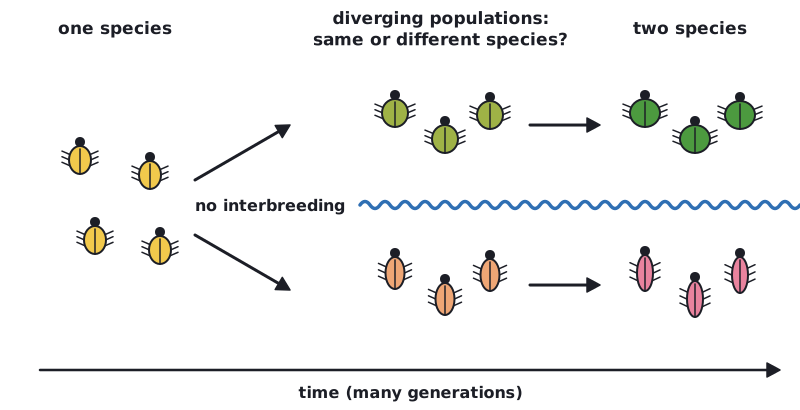
Speciation usually happens gradually rather than by a single act. When populations stop interbreeding, each one changes independently, so they become more and more different in their traits. There is no clear moment when two populations become two species.
At an intermediate stage, populations may be partly different, with some interbreeding still possible. It can therefore be an arbitrary decision whether two populations are regarded as the same species or different species.
 (opens full size in a new tab)
Written and checked against the IB Biology SL specification · Updated October 2026