
Homologous and analogous structuresSpec A4.1.4, A4.1.5
In short
Homologous structures have the same basic structure in different species because they were inherited from a common ancestor, even if their functions now differ, as in the pentadactyl limb of humans, bats and whales. Analogous structures have the same function but different evolutionary origins. They arise by convergent evolution, as in the wings of birds and insects.
Homologous structures have the same basic structure in different species because they were inherited from a common ancestor, even though they may now have different functions. They are evidence of common ancestry followed by divergence.
The pentadactyl limb
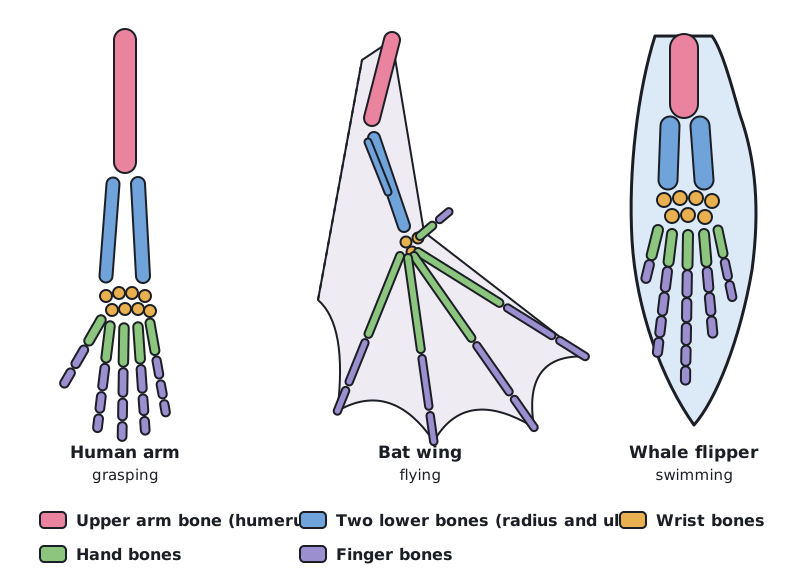
The limbs of amphibians, reptiles, birds and mammals are built on the same five-digit (pentadactyl) plan:
- one bone in the upper limb: humerus (forelimb) or femur (hindlimb)
- two bones in the lower limb: radius and ulna, or tibia and fibula
- a group of wrist or ankle bones: carpals or tarsals
- a set of bones in the palm or sole: metacarpals or metatarsals
- five digits made of phalanges
 (opens full size in a new tab)
| Forelimb | Function | How the plan is modified |
|---|---|---|
| Human arm | Grasping and manipulating | Long separate digits with an opposable thumb |
| Bat wing | Flying | Very long metacarpals and phalanges support a membrane of skin |
| Whale flipper | Swimming | Short, flattened bones enclosed in a paddle |
| Bird wing | Flying | Carpals and metacarpals fused, digits reduced |
There is no functional reason why a flipper, a wing and a hand need the same bones. The shared plan is best explained by descent from a common ancestor with a pentadactyl limb.
Convergent evolution and analogous structures
Analogous structures have the same function but different evolutionary origins. They arise by convergent evolution: unrelated lineages meet similar selection pressures, so natural selection produces similar adaptations independently.
- Wings of birds and insects: a bird wing is a modified forelimb with bones and feathers; an insect wing is an outgrowth of the exoskeleton with no bones.
- Camera eyes of octopuses and vertebrates: both focus light with a lens onto a retina, but they develop differently and the octopus retina has no blind spot.
- Streamlined bodies and fins of sharks (fish) and dolphins (mammals).
| Homologous | Analogous | |
|---|---|---|
| Evolutionary origin | Same, from a common ancestor | Different |
| Function | Often different | Same |
| Type of evolution | Divergent | Convergent |
| Example | Pentadactyl limbs | Bird and insect wings |
Linking question: what counts as strong evidence in biology? Homologous structures, sequence data and selective breeding are independent lines of evidence that all support common ancestry.
Written and checked against the IB Biology SL specification · Updated October 2026