
Cell size and surface area-to-volume ratioSpec B2.3.5, B2.3.6
In short
Cell size is an aspect of specialization: human cells range from small sperm and red blood cells to large egg cells, very long neurons and striated muscle fibres. Size is limited by surface area-to-volume ratio, because exchange across the surface depends on area, while the need for exchange depends on volume, which grows faster as cells enlarge.
Cell size as an aspect of specialization
Human cells vary greatly in size, and the size of each type suits its function.
| Cell | Approximate size | Link to function |
|---|---|---|
| Sperm (male gamete) | Head about 5 µm long; whole cell about 50–60 µm long | Small and streamlined, with little cytoplasm, so it can swim to the egg |
| Egg (female gamete) | About 110 µm (0.1 mm) in diameter, at the limit of what the naked eye can see | Large, with cytoplasm and nutrients for the early embryo |
| Red blood cell | About 7–8 µm in diameter | Small and flexible, so it can squeeze through narrow capillaries |
| White blood cells | About 7–20 µm in diameter, from small lymphocytes (similar to a red blood cell) to monocytes | Most are larger than red blood cells; phagocytes are large enough to engulf bacteria |
| Neuron | Cell body up to about 100 µm across; axons up to about 1 m long | Long axons carry impulses over long distances, such as from the spinal cord to the foot |
| Striated muscle fibre | Up to about 100 µm wide and many centimetres long | Long fibres contract along their whole length |
Surface area-to-volume ratio
A cell exchanges materials such as oxygen, nutrients and waste across its surface, so the rate of exchange depends on its surface area. The need for exchange depends on how much cytoplasm is carrying out metabolism, which is the cell's volume.
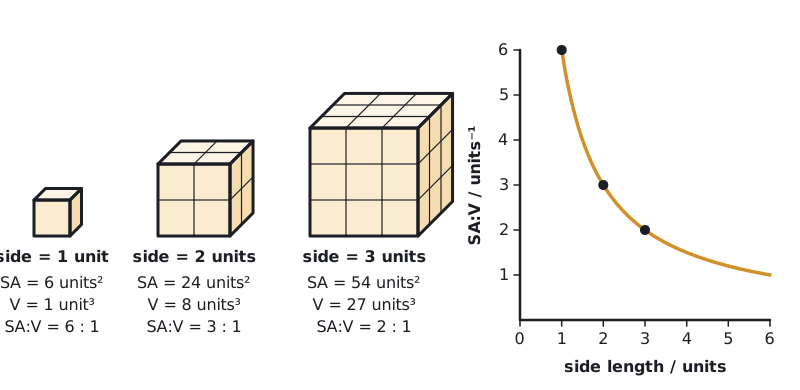
As a cell gets larger, its volume increases faster than its surface area. For a cube of side length L, surface area = 6L² but volume = L³, so the surface area-to-volume ratio (6 ÷ L) falls as L increases. A large cell may not be able to exchange materials fast enough to meet its needs, and the distance from the surface to the centre becomes long for diffusion. This constrains cell size.
Calculating SA:V
Model two cells as cubes with sides of 10 µm and 20 µm. Calculate the surface area-to-volume ratio of each and state the effect of doubling the side length.
- 10 µm cube: surface area = 6 × 10² = 600 µm²; volume = 10³ = 1000 µm³
- SA:V = 600 ÷ 1000 = 0.6 µm⁻¹ (0.6 : 1)
- 20 µm cube: surface area = 6 × 20² = 2400 µm²; volume = 20³ = 8000 µm³
- SA:V = 2400 ÷ 8000 = 0.3 µm⁻¹ (0.3 : 1)
Answer: Doubling the side length multiplies surface area by 4 but volume by 8, so SA:V halves, from 0.6 to 0.3 µm⁻¹.
Give SA:V in µm⁻¹ (or cm⁻¹) or as a ratio such as 0.6 : 1. Work out surface area (squared units) and volume (cubed units) separately before dividing.
Model SA:V with agar cubes of different side lengths containing an indicator, placed in acid. The percentage of each cube's volume that changes colour in a fixed time shows how exchange falls behind as cubes get larger. Models are simplified: cubes are simpler than real cells, but scale factors work in the same way.
 (opens full size in a new tab)
Linking question: what are the advantages of small size and large size in biological systems? Small cells exchange materials quickly; large organisms need extra adaptations such as lungs and a circulatory system.
Quick check
State the two properties of stem cells.
Show answer
They can divide endlessly and differentiate along different pathways.
Name two stem cell niches in adult humans.
Show answer
Bone marrow and hair follicles.
What type of stem cell is found in adult bone marrow?
Show answer
Multipotent.
What happens to the SA:V of a cube when its side length doubles?
Show answer
It halves.
Written and checked against the IB Biology SL specification · Updated October 2026