
RNA polymers and the DNA double helix

Molecules (Unity and diversity) · Nucleic acids · note 2 of 4

RNA polymers and the DNA double helixSpec A1.2.5, A1.2.6

In short

RNA is a polymer formed by condensation of nucleotide monomers: each new bond between the phosphate of one nucleotide and the sugar of the next releases a water molecule. DNA is a double helix of two antiparallel strands of nucleotides, linked by hydrogen bonds between complementary base pairs, with adenine paired to thymine and guanine paired to cytosine.

RNA as a polymer

RNA is a polymer formed by condensation of nucleotide monomers. When two nucleotides are joined, the phosphate of one bonds covalently to the sugar (ribose) of the other and a molecule of water is released. Repeating this builds a single strand of any length, with a sugar–phosphate backbone and one base on each nucleotide.
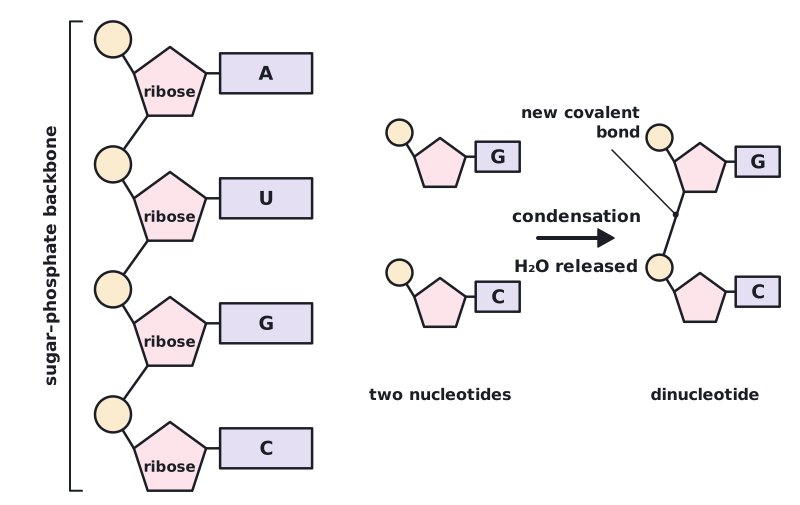
A vertical RNA strand of four nucleotides, each with ribose and bases A, U, G and C, with a bracket labelling the sugar–phosphate backbone; beside it two separate nucleotides join by condensation, releasing H₂O, to form a dinucleotide with a new covalent bond. (opens full size in a new tab)
RNA is a polymer of nucleotides. Each new sugar–phosphate bond forms by condensation, releasing a molecule of water.

DNA as a double helix

  • DNA has two strands of nucleotides, wound into a double helix.
  • The two strands are antiparallel: they run in opposite directions.
  • The bases face inwards and the two strands are linked by hydrogen bonds between bases.
  • Pairing is complementary: adenine (A) pairs with thymine (T) and guanine (G) pairs with cytosine (C).
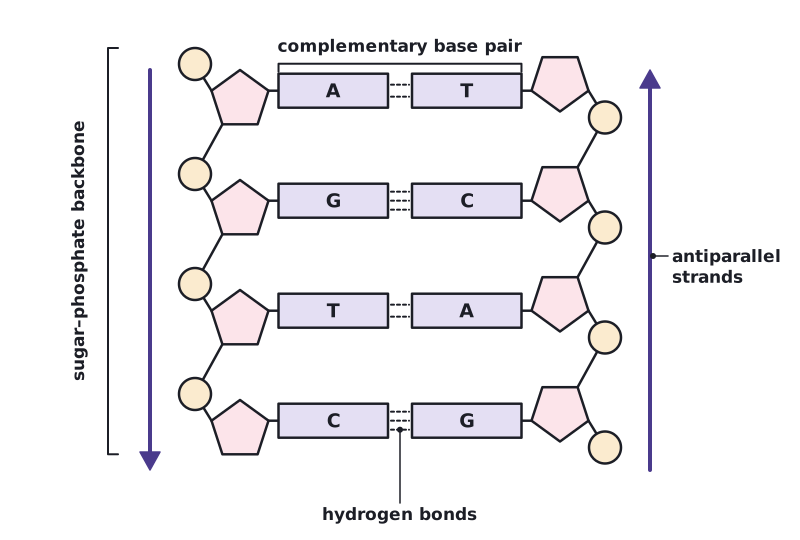
A ladder diagram of DNA with four base pairs A–T, G–C, T–A and C–G joined by dashed hydrogen bonds; the right strand is drawn upside down and arrows beside the strands point in opposite directions, labelled antiparallel strands, with the sugar–phosphate backbone and a complementary base pair labelled. (opens full size in a new tab)
DNA: two antiparallel strands (one drawn upside down), linked by hydrogen bonds between complementary base pairs, A with T and G with C.
Exam tip:

In DNA diagrams draw the two strands antiparallel (one strand upside down) and pair A with T and G with C. You do not need to draw the helix, the relative sizes of the bases or the number of hydrogen bonds.

Exam tip:

Linking question: how can polymerization result in emergent properties? A single nucleotide stores no information, but a polymer of thousands of them stores a whole gene.

Written and checked against the IB Biology SL specification · Updated October 2026

Frequently asked questions

What is the structure of a DNA nucleotide?

A DNA nucleotide has a phosphate group, the pentose sugar deoxyribose and a nitrogenous base, which is adenine, thymine, guanine or cytosine. The phosphate and base are attached to the sugar on opposite sides. Nucleotides link through sugar–phosphate bonding to form a strong covalent backbone with the bases sticking out.

Why is DNA described as antiparallel?

DNA is described as antiparallel because its two strands run in opposite directions. The strands are held together by hydrogen bonds between complementary bases, adenine with thymine and guanine with cytosine. In diagrams, one strand is drawn upside down relative to the other to show this.

What are the main differences between DNA and RNA?

DNA is double-stranded, while RNA is single-stranded. DNA contains the base thymine, while RNA has uracil instead. DNA contains the sugar deoxyribose, while RNA contains ribose, which has an OH group on carbon 2 where deoxyribose has only hydrogen. Examples of RNA are mRNA, tRNA and rRNA.

All 4 questions on Nucleic acids