
Populations and random samplingSpec C4.1.1, C4.1.2, C4.1.3
In short
A population is an interacting group of organisms of the same species living in an area. Members normally breed with each other, and reproductive isolation separates one population from another. Population size is usually estimated by random sampling, for example with randomly placed quadrats for sessile organisms, because counting every individual is rarely possible.
- Population
- An interacting group of organisms of the same species living in an area.
- Sampling error
- The difference between the estimate of population size from a sample and the true size of the whole population.
- Sessile
- Fixed in one place, not moving about: for example plants, barnacles and mussels.
Members of a population normally breed with each other. Two populations of the same species are distinguished by reproductive isolation: individuals in one population rarely or never breed with individuals in the other, for example because a mountain range, a stretch of sea or a different breeding season separates them.
Why estimate rather than count?
Counting every individual is usually impossible or impractical: the area is too large, the organisms are too numerous, too small or hidden, and counting would take too long or disturb the habitat. Ecologists therefore count a sample and scale up. Samples must be random, so that every individual or every part of the area has an equal chance of being included. A sampler who chooses where to look introduces bias (for example, towards dense patches).
Because only a sample is measured, the estimate will almost always differ from the true value. This sampling error is unavoidable, but it is reduced by taking more samples and by randomising them properly.
Random quadrat sampling
- Mark out the sampling area with two tape measures at right angles to form a grid.
- Use a random number generator to pick coordinates and place a quadrat of known area (for example 1 m²) at each one.
- Count the individuals of the species inside each quadrat (use a rule for those on the edge, such as counting only those touching two sides).
- Repeat for many quadrats and calculate the mean number per quadrat.
- Population size estimate = mean number per m² × total area in m².
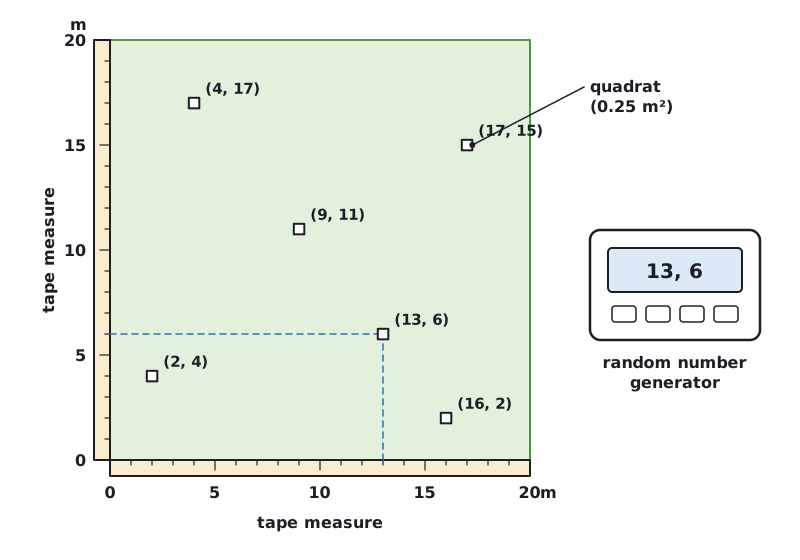 (opens full size in a new tab)
This method suits sessile organisms, plants or animals, where the individuals in a quadrat can be counted. It does not work for animals that move in and out of the quadrat.
The standard deviation of the mean number per quadrat measures the spread of the counts. A small SD means the population is spread fairly evenly; a large SD means it is clumped. You do not need to memorise the formula: calculate it on a calculator or spreadsheet.
Estimating a population from quadrats
Ten random 1 m² quadrats in a 500 m² meadow contain 3, 5, 0, 2, 6, 4, 1, 3, 5 and 1 plantain plants. Estimate the population size.
- Total = 3 + 5 + 0 + 2 + 6 + 4 + 1 + 3 + 5 + 1 = 30 plants.
- Mean = 30 ÷ 10 = 3.0 plants per m².
- Estimate = 3.0 × 500 = 1500 plants.
Answer: About 1500 plantain plants (an estimate, subject to sampling error).
Written and checked against the IB Biology SL specification · Updated October 2026