
Base pairing, information storage and the genetic codeSpec A1.2.8, A1.2.9, A1.2.10
In short
Complementary base pairing, based on hydrogen bonding, lets genetic information be replicated and expressed: each DNA strand acts as a template for a new strand, mRNA is copied from DNA, and tRNA anticodons pair with mRNA codons. Any length and base sequence is possible, giving DNA limitless storage capacity, and the conserved genetic code is evidence of universal common ancestry.
Complementary base pairing
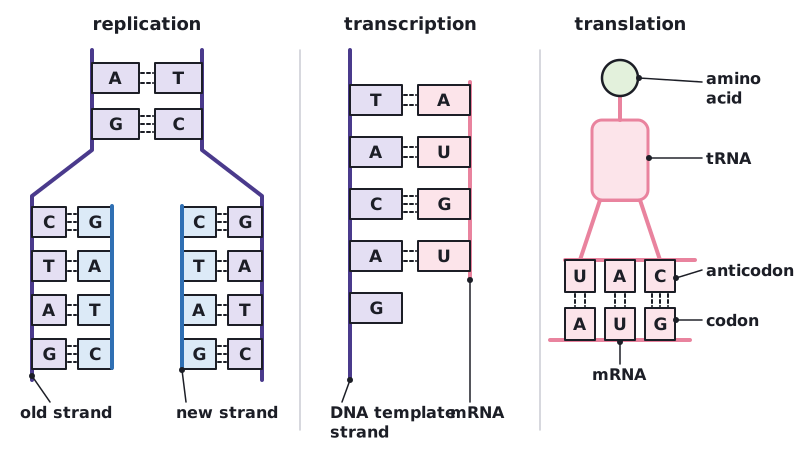
Complementarity is based on hydrogen bonding: A and T (or A and U in RNA) form hydrogen bonds with each other, and so do G and C. Other combinations do not fit and do not bond properly. So the sequence on one strand fixes the sequence on the other.
- Replication: the two strands separate and each acts as a template. Free nucleotides pair with complementary bases, so two identical DNA molecules are produced.
- Transcription (expression): an mRNA molecule is built with bases complementary to one strand of a gene, with U pairing with A.
- Translation (expression): each tRNA anticodon pairs with a complementary mRNA codon, so amino acids are added in the order the code specifies.
Limitless capacity for storing information
There is no restriction on the order of bases along a strand, and a DNA molecule can be any length. So any base sequence is possible and the diversity of possible sequences is effectively limitless. With 4 bases, the number of possible sequences of length n is 4ⁿ. DNA also stores data with great economy: the human genome of about 3 billion base pairs fits inside a nucleus only a few micrometres across.
Number of possible base sequences
How many different base sequences are possible for a DNA strand 10 nucleotides long?
- Each position can hold any one of 4 bases.
- Number of sequences = 4 × 4 × … (10 times) = 4¹⁰.
- 4¹⁰ = 1 048 576.
Answer: About one million (1 048 576) sequences, from just 10 nucleotides.
Possible sequences = 4ⁿ for DNA of length n nucleotides. Each extra nucleotide multiplies the number of possibilities by 4.
A universal genetic code
The genetic code, the way base triplets (codons) correspond to amino acids, is conserved across all life forms, with only a few minor variations. It is very unlikely that so many organisms would arrive at the same arbitrary code independently. The best explanation is that all living organisms inherited it from a universal common ancestor. This is also why a gene from one species can be expressed in another.
 (opens full size in a new tab)
Quick check
What are the three components of a nucleotide?
Show answer
A phosphate group, a pentose sugar and a nitrogenous base.
State three differences between DNA and RNA.
Show answer
DNA has two strands, RNA one; DNA has thymine, RNA uracil; DNA has deoxyribose, RNA ribose.
What does antiparallel mean in DNA?
Show answer
The two strands run in opposite directions.
Written and checked against the IB Biology SL specification · Updated October 2026