
Capture–mark–release–recapture and the Lincoln indexSpec C4.1.4
In short
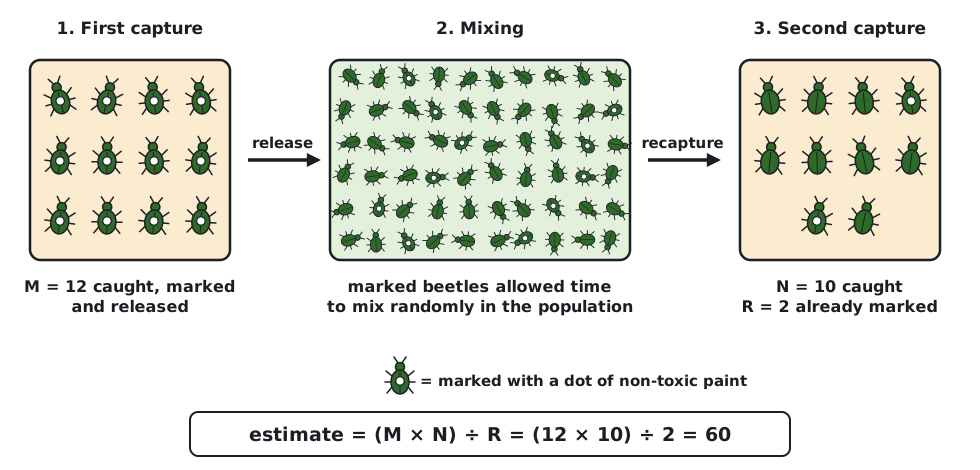
Capture–mark–release–recapture estimates the size of a population of motile animals. A sample is caught, marked and released; later a second sample is caught and the marked individuals in it are counted. The Lincoln index gives the estimate: population size = (M × N) ÷ R. It assumes marked animals mix randomly and are as likely to be recaught.
Animals that move about (motile organisms) cannot be counted in quadrats. Instead, the proportion of marked animals in a second sample is used to estimate the whole population.
- Capture as many individuals as possible in a set time with a suitable method (pitfall traps for beetles, sweep nets for insects, small mammal traps).
- Mark each one in a way that does not harm it or make it more visible to predators (a dot of non-toxic paint, a fur clip, a ring). Count them: this is M.
- Release them where they were caught and allow time for them to mix back into the population.
- Capture a second sample with the same method and effort. Count the total caught (N) and the number already marked (R).
M = number caught and marked initially; N = total number recaptured in the second sample; R = number of marked individuals recaptured.
Using the Lincoln index
In a woodland, 45 ground beetles are caught in pitfall traps, marked and released. Two days later 60 beetles are caught, of which 15 are marked. Estimate the population.
- M = 45, N = 60, R = 15.
- Estimate = (45 × 60) ÷ 15 = 2700 ÷ 15.
- = 180.
Answer: About 180 ground beetles.
Assumptions
- Marking does not harm the animals or change their behaviour or chance of being eaten.
- Marks are not lost (worn off or moulted) between the two samples.
- Marked individuals mix randomly back into the whole population before the second sample.
- Marked and unmarked animals have an equal chance of being caught (no trap-shyness or trap-happiness).
- No significant births, deaths, immigration or emigration between the two samples.
Check your answer is at least as big as M + N − R, the number of different animals actually seen. If R is very small, the estimate is very unreliable.
 (opens full size in a new tab)
Written and checked against the IB Biology SL specification · Updated October 2026