
Substitutions, insertions and deletionsSpec D1.3.1, D1.3.2, D1.3.3
In short
Gene mutations are structural changes to genes at the molecular level: substitutions, insertions or deletions of bases. A base substitution produces a single-nucleotide polymorphism (SNP), which may or may not change one amino acid because the code is degenerate. Insertions and deletions often cause a frameshift, changing every later codon, so the polypeptide is likely to stop functioning.
A gene mutation is a structural change to a gene at the molecular level: a change to its base sequence. There are three types.
| Type | Change | Example (coding strand) |
|---|---|---|
| Substitution | One base is replaced by a different base. | GAG → GTG |
| Insertion | One or more extra nucleotides are added. | GAG CTA → GAA GCT A… |
| Deletion | One or more nucleotides are lost. | GAG CTA → GGC TA… |
Consequences of base substitutions
Single-nucleotide polymorphisms (SNPs) are positions in the genome where a single base differs between individuals. They are the result of base substitution mutations. A substitution changes only one codon, and because of the degeneracy of the genetic code it may or may not change a single amino acid:
- Same amino acid: the new codon codes for the same amino acid (for example GAA → GAG, both glutamic acid). The polypeptide is unchanged.
- Different amino acid: one amino acid in the polypeptide is changed (for example GAG → GUG, glutamic acid → valine). The effect may be small or, as in sickle-cell anaemia, large.
- Stop codon: the codon becomes a stop codon (for example UAC → UAA), so the polypeptide is cut short and is usually non-functional.
Consequences of insertions and deletions
Because mRNA is read in non-overlapping triplets, inserting or deleting one or two nucleotides shifts the reading frame. This frameshift changes every codon after the mutation, so the amino acid sequence from that point is altered and a premature stop codon often appears. The polypeptide is very likely to cease to function.
Inserting or deleting a multiple of three nucleotides does not cause a frameshift, but adds or removes amino acids. Major insertions or deletions of many nucleotides also make it likely that the polypeptide stops functioning.
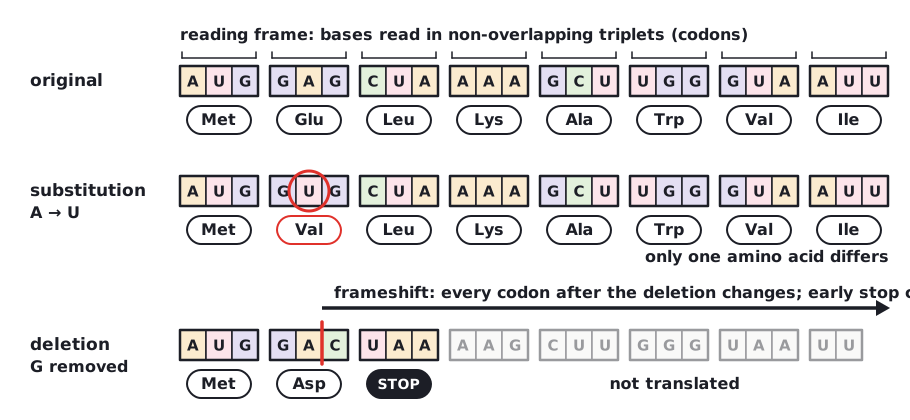 (opens full size in a new tab)
Linking question: how does variation in subunit composition of polymers contribute to function? A single changed nucleotide in DNA can change one amino acid in a protein and alter its function.
Written and checked against the IB Biology SL specification · Updated October 2026