
PCR and gel electrophoresisSpec D1.1.4
In short
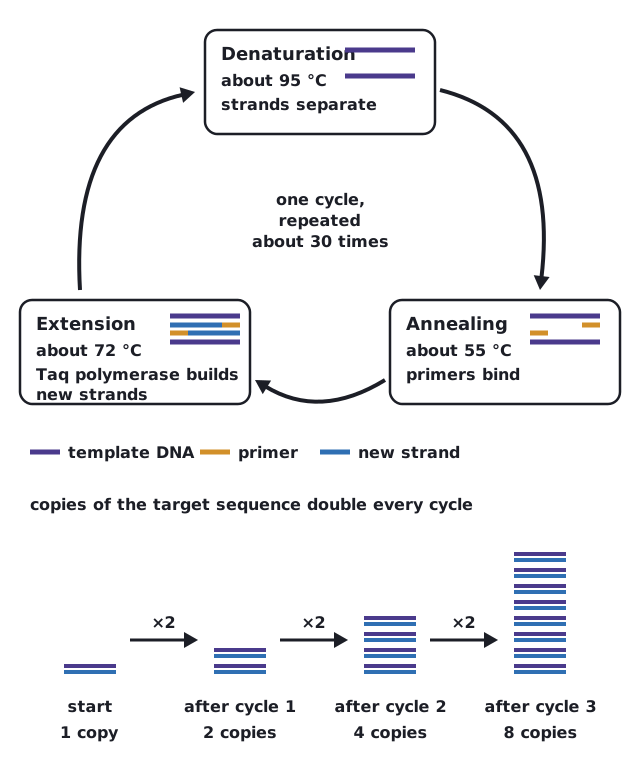
The polymerase chain reaction (PCR) amplifies a chosen DNA sequence. Cycles at about 95 °C, 55 °C and 72 °C separate the strands, bind primers and let heat-stable Taq polymerase build new strands, doubling the DNA each cycle. Gel electrophoresis then separates fragments by length, as negatively charged DNA moves towards the positive electrode.
Polymerase chain reaction (PCR)
The polymerase chain reaction (PCR) makes millions of copies of a chosen DNA sequence from a tiny sample. The reaction mixture contains the sample DNA, free DNA nucleotides, two primers and Taq polymerase, in a buffer. A thermal cycler changes the temperature in repeated cycles.
| Stage | Typical temperature | What happens |
|---|---|---|
| Denaturation | about 95 °C | Hydrogen bonds between the strands break, so the double helix separates into single strands. |
| Annealing | about 50–65 °C (often about 55 °C) | Primers bind by complementary base pairing to the ends of the target sequence on each single strand. |
| Extension | about 72 °C | Taq polymerase adds nucleotides to the primers, building a new complementary strand. |
- Primers are short single-stranded sequences of DNA. Two different primers are used, one for each strand, and they mark the two ends of the sequence to be copied. DNA polymerase can only add nucleotides to an existing strand, so the primer gives it a starting point.
- Taq polymerase is a DNA polymerase from Thermus aquaticus, a bacterium of hot springs. It is not denatured at 95 °C and works best at about 72 °C, so it survives every cycle and does not need to be replaced.
- Temperature changes drive the cycle: high temperature separates strands, a lower temperature allows primers to bind, and an intermediate temperature suits Taq polymerase.
Each cycle doubles the number of copies of the target sequence, so the amount of DNA increases exponentially. Thirty cycles typically take one to two hours.
Maths skill: copies after PCR
A sample contains 50 copies of a target DNA sequence. How many copies are present after 20 cycles of PCR, assuming each cycle doubles the DNA?
- 2²⁰ = 1 048 576
- 50 × 1 048 576 = 52 428 800
Answer: About 5.2 × 10⁷ copies.
Gel electrophoresis
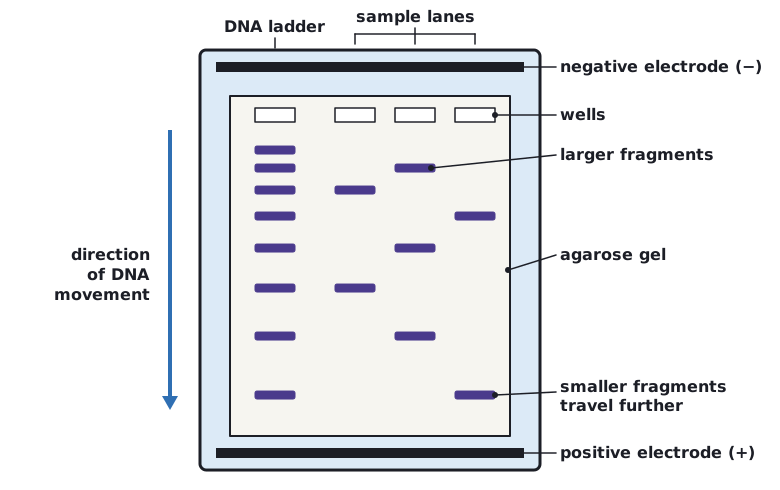
Gel electrophoresis separates DNA fragments according to their length. Samples are placed in wells at one end of an agarose gel and a voltage is applied. DNA has a negative charge (from its phosphate groups), so fragments move through the gel towards the positive electrode. The gel acts like a mesh: smaller fragments move faster and travel further than larger ones in the same time.
A DNA ladder (a mixture of fragments of known lengths) is run in one lane so that fragment sizes can be estimated. The DNA is stained so that the bands can be seen.
 (opens full size in a new tab)
 (opens full size in a new tab)
When reading a gel, compare each band with the ladder lane. Bands at the same distance from the wells in different lanes are fragments of the same length.
Written and checked against the IB Biology SL specification · Updated October 2026