
Solvation and osmosisSpec D2.3.1, D2.3.2, D2.3.3
In short
Osmosis is the net movement of water across a partially permeable membrane from a less concentrated solution to a more concentrated solution. Solutes dissolve because water forms hydrogen bonds with polar molecules and is attracted to positive and negative ions. In an isotonic environment there is dynamic equilibrium, not zero water movement.
Solvation
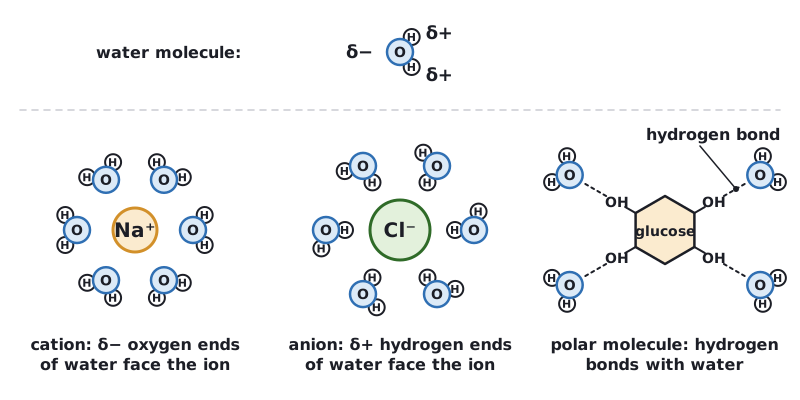
Solvation is the process of a solute dissolving, with each solute particle surrounded by solvent molecules. Water is a good solvent because its molecules are polar: the oxygen end is slightly negative (δ−) and the hydrogen ends are slightly positive (δ+).
- Positively charged ions (for example Na⁺) attract the δ− oxygen ends of water molecules.
- Negatively charged ions (for example Cl⁻) attract the δ+ hydrogen ends of water molecules.
- Polar molecules such as glucose form hydrogen bonds with water molecules.
Each ion or molecule becomes surrounded by a shell of water molecules, so it separates from the others and dissolves.
 (opens full size in a new tab)
Direction of water movement
Osmosis is the net movement of water through a partially permeable membrane. Water moves from the less concentrated solution to the more concentrated solution, meaning from lower to higher solute concentration. Water molecules bound to solutes move less freely, so more water molecules cross from the side with fewer solutes.
- Hypertonic
- Having a higher solute concentration than another solution.
- Hypotonic
- Having a lower solute concentration than another solution.
- Isotonic
- Having the same solute concentration as another solution.
Osmosis into and out of cells
| Environment of the cell | Net movement of water |
|---|---|
| Hypotonic (lower solute concentration than the cytoplasm) | Into the cell |
| Hypertonic (higher solute concentration than the cytoplasm) | Out of the cell |
| Isotonic | No net movement: water moves in and out at equal rates (dynamic equilibrium) |
Describe direction in terms of solute concentration, not water concentration. And in an isotonic solution water still moves; the rates in and out are just equal.
Written and checked against the IB Biology SL specification · Updated October 2026