
Evidence from sequences and selective breedingSpec A4.1.2, A4.1.3
In short
Base sequences in DNA or RNA and amino acid sequences in proteins give powerful evidence of common ancestry: the fewer differences between two species, the more recently they shared an ancestor. Selective breeding of domesticated animals and crop plants gives further evidence, showing that heritable characteristics of a population can change greatly and rapidly when there is selection.
Base and amino acid sequences
All cellular organisms store genetic information as DNA and use almost the same genetic code. This shared chemistry points to a single common origin of life. Comparing sequences between species gives powerful evidence of common ancestry.
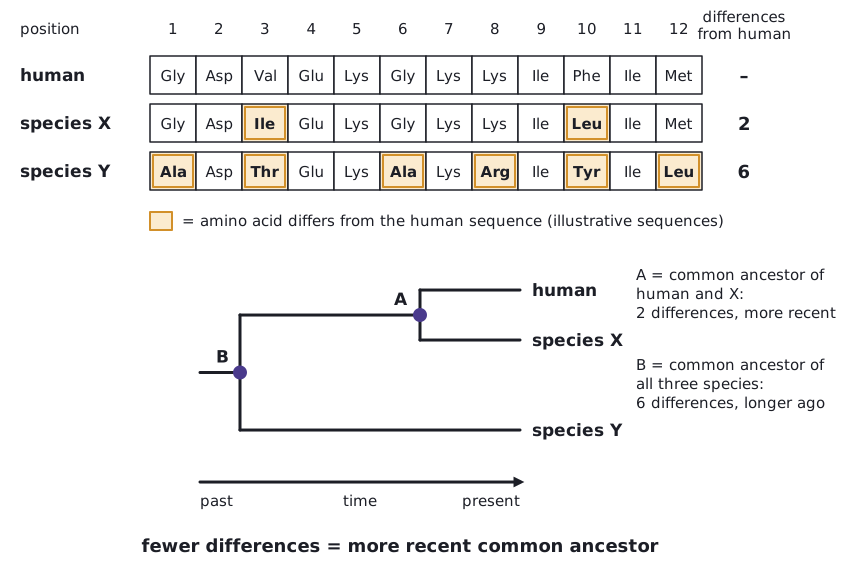
- Mutations change base sequences over time. Once two populations have separated, each lineage accumulates its own mutations.
- So the fewer differences between the base sequences of a gene (or the amino acid sequences of a protein) in two species, the more recently they shared a common ancestor.
- Proteins found in a very wide range of species, such as cytochrome c (used in respiration) and haemoglobin, are often compared.
- If differences accumulate at a roughly steady rate, the number of differences can also be used to estimate how long ago two lineages diverged.
Base sequences show more differences than amino acid sequences. The genetic code is degenerate, so some base substitutions do not change the amino acid.
Sequence evidence is independent of anatomy, yet the relationships it shows mostly agree with those based on structure. When independent lines of evidence point the same way, the evidence is strong.
 (opens full size in a new tab)
Selective breeding
In selective breeding (artificial selection), humans choose individuals with desired traits to breed, generation after generation. Domesticated breeds and crop varieties now differ greatly from each other and from the original wild species.
- Wild cabbage (Brassica oleracea) has been bred into cabbage, kale, broccoli, cauliflower, Brussels sprouts and kohlrabi, by selecting for large leaves, flower buds, side buds or swollen stems.
- All dog breeds, from chihuahuas to great Danes, descend from domesticated wolves.
- Maize was bred from the wild grass teosinte, which has tiny ears with a few hard-cased grains.
This shows how rapidly evolutionary change can occur: large heritable changes in a few thousand years or less. If human selection can do this, natural selection acting over millions of years can produce far greater changes.
Selective breeding is evidence that populations can change, but it is not natural selection. The selecting agent is humans, not the environment.
Written and checked against the IB Biology SL specification · Updated October 2026