
Anthropogenic species extinction and ecosystem lossSpec A4.2.3, A4.2.4
In short
Anthropogenic extinction is caused by human activity and drives the current sixth mass extinction. The North Island giant moa was hunted to extinction soon after human settlement of New Zealand, and the Caribbean monk seal was killed for oil and lost its food. Mixed dipterocarp forest in Southeast Asia is lost through logging, clearance for plantations and fire.
The current sixth mass extinction is anthropogenic: it is caused by human activity, unlike the earlier mass extinctions. Brief case studies show a range of causes.
North Island giant moa: loss of terrestrial megafauna
The North Island giant moa (Dinornis novaezealandiae) was a very large flightless bird of New Zealand, where the only native land mammals were bats. It became extinct within about two centuries of the arrival of Polynesian settlers, the ancestors of Māori, around 1300 CE.
- Hunting for meat, and collection of eggs, by people.
- Burning and clearing of forest habitat.
- Slow breeding: small clutches and many years to reach maturity, so populations could not recover from hunting.
- No evolved fear of land predators, so birds were easy to kill.
Caribbean monk seal: loss of a marine species
The Caribbean monk seal (Neomonachus tropicalis) lived on beaches, islands and reefs of the Caribbean Sea and Gulf of Mexico. The last confirmed sighting was in 1952, and it was declared extinct in 2008.
- From the late 15th century, European settlers hunted it for oil from its blubber, and for meat and skins. Seals resting on beaches were easy to kill.
- Overfishing of reef fish and invertebrates reduced its food.
- Disturbance of the beaches where it rested and bred.
A local case study: the Arabian ostrich
The Arabian ostrich (Struthio camelus syriacus), a subspecies of ostrich, lived in the deserts of the Arabian Peninsula and nearby regions. It was hunted for meat, feathers and eggs for centuries, and declined rapidly in the 20th century once firearms and motor vehicles made hunting far easier. The last reliable records are from around 1939 to 1941, and a single dying bird reported in Jordan in 1966 is the date usually given for its extinction. Any species lost from an area you know can be used as the third case study.
Ecosystem loss
An ecosystem is lost when its community and abiotic conditions are changed so much that it no longer functions as before. Only causes that are directly or indirectly anthropogenic are studied here.
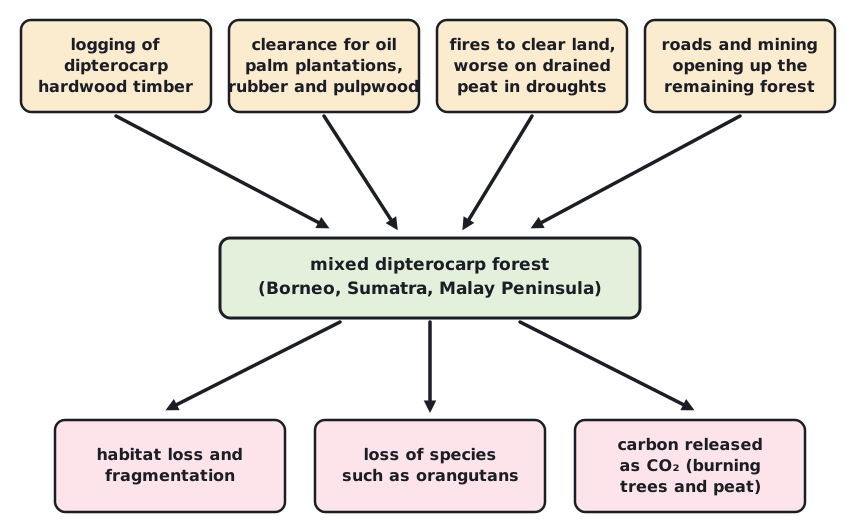
Mixed dipterocarp forest in Southeast Asia. These lowland rainforests of Borneo, Sumatra and the Malay Peninsula are dominated by tall trees of the family Dipterocarpaceae and are home to very many species, including orangutans. Large areas have been lost.
- Logging of valuable dipterocarp hardwood timber.
- Clearance of land for oil palm plantations, and for rubber and pulpwood.
- Fires set to clear land, which spread further in drought years and on drained peat soils.
- Roads and mining that open up remaining forest, leaving small fragments too small for many species.
A local case: coral reefs of the southern Arabian Gulf. Reefs off the UAE already live close to the upper temperature limit for corals. In summer 2017, weak winds failed to cool the shallow sea, and water stayed hot enough for long enough to bleach about 95 % of the corals off Abu Dhabi. By April 2018 about three-quarters (73 %) of them had died, including normally heat-tolerant species. The causes are indirectly anthropogenic, as climate change makes marine heatwaves more frequent, and directly anthropogenic, as dredging, land reclamation for coastal development and sewage discharge add stress. Another well-known example is the Aral Sea in Central Asia, whose lake ecosystem largely collapsed after its feeder rivers were diverted to irrigate cotton from the 1960s.
 (opens full size in a new tab)
Give the specific cause for each case study: overhunting of a slow-breeding bird for the moa, hunting for oil and loss of food for the monk seal, and logging, plantations and fire for dipterocarp forest.
Written and checked against the IB Biology SL specification · Updated October 2026